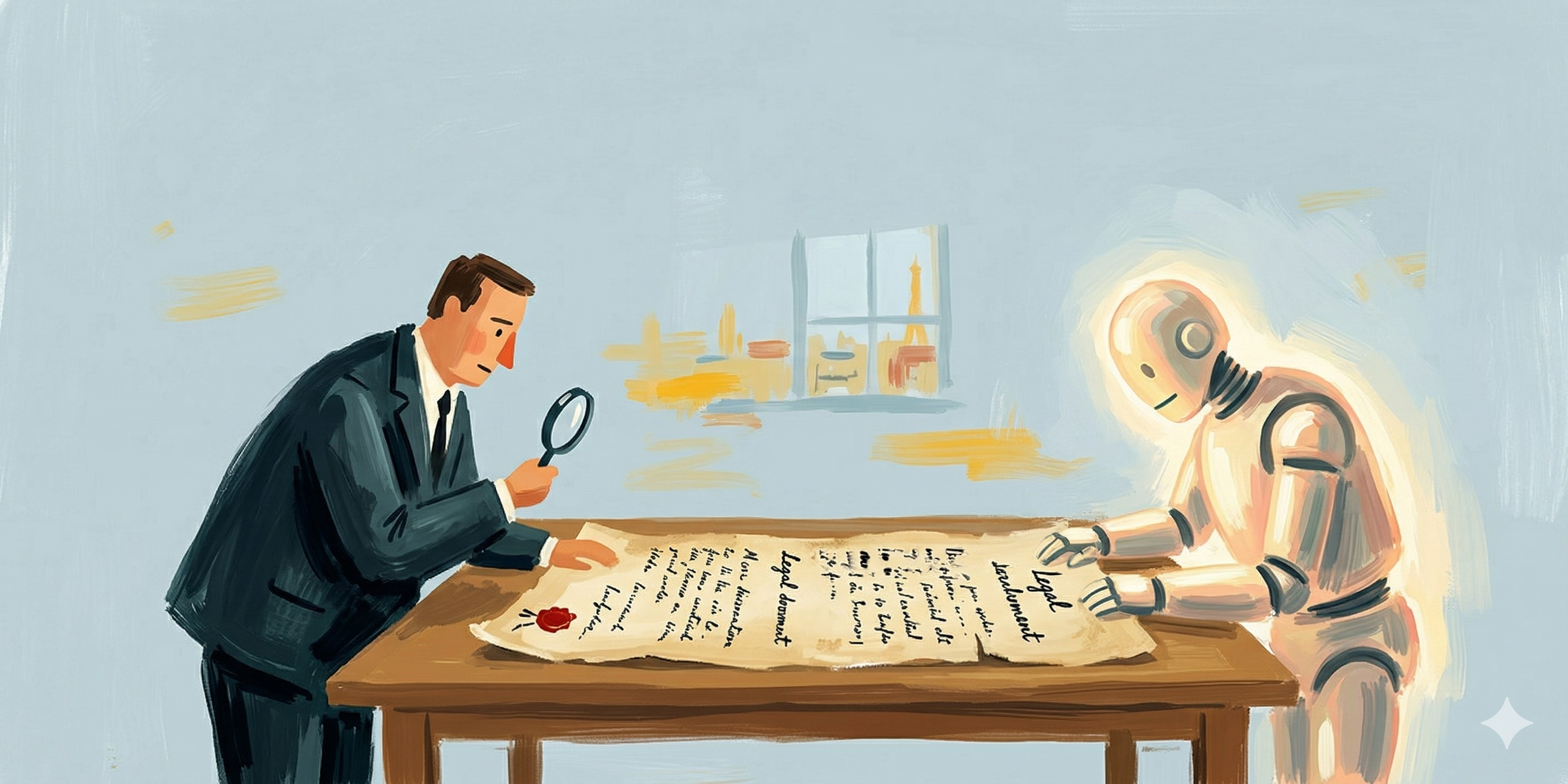
This comparison analyzes costs, speed, accuracy, and judgment quality for AI tools versus human attorneys across different contract scenarios. We distinguish between scenarios where each approach is stronger.
| Criterion | Weight | How Scored |
|---|---|---|
| Cost Efficiency | 25% | Total cost per contract review including subscription fees, attorney hourly rates, and follow-up costs |
| Speed | 15% | Time from submission to actionable output (AI: seconds to minutes; attorney: hours to days) |
| Issue Detection | 25% | Ability to identify problematic clauses in standardized contracts based on published benchmarks |
| Contextual Judgment | 25% | Ability to assess business context, negotiation leverage, jurisdiction-specific nuance, and strategic implications |
| Accountability | 10% | Whether the reviewer carries professional liability, malpractice insurance, or fiduciary duty |
Test Parameters
- Dataset:
- Cost and performance data compiled from published attorney rate surveys, AI tool pricing pages, and the 2018 LawGeex benchmark study
- Contract types:
- NDA, Employment Agreement, Commercial Lease, Vendor Agreement
- Process:
- We compiled published data on attorney costs (Clio 2024 Legal Trends Report), AI tool pricing, and the LawGeex 2018 NDA benchmark. For subjective criteria (contextual judgment, accountability), we describe each approach's structural strengths and limitations rather than assigning numerical scores. This article does not recommend one approach over the other — it identifies when each is the better choice.
Use AI for routine contracts, hire a lawyer for high-stakes ones, and use both for everything in between.
Attorney contract review runs $340 to $730 depending on the document type, while AI tools analyze the same contract in under a minute for $0 to $5. The smart move is knowing which contracts justify $349/hour attorney time and which ones you are overpaying for by not running through AI first.
This article gives you a contract-type-by-contract-type breakdown: what each approach costs, where each one falls short, and the one structural difference between the two that should drive your decision. For the technical background on how AI contract review works, see our explainer.
What AI Contract Review Actually Does (and Doesn’t)
AI contract review tools parse your document clause by clause, flag terms that deviate from market norms, and explain what each provision means in plain language. That’s the core function. Here’s what that looks like in practice, and where it stops.
What AI Does Well
- Flags risky clauses. One-sided indemnification, aggressive non-competes, unusually broad IP assignments, low liability caps: AI tools catch these patterns because they have been trained on thousands of contracts.
- Explains legalese in plain English. A clause reading “Party shall indemnify, defend, and hold harmless...” becomes “You’re agreeing to pay for the other side’s legal costs if they get sued because of your work.”
- Compares document versions. Upload a redlined draft and the original, and AI identifies every change. This is useful when a counterparty sends back an “identical” contract with subtle modifications you need to catch.
- Works in minutes. A 2018 LawGeex study found AI reviewed NDAs in 26 seconds with 94% accuracy (per a 2018 LawGeex-funded study of NDAs), compared to 92 minutes and 85% for experienced attorneys in the same study. The study was company-sponsored and is now eight years old, but the speed gap has only widened since then.
- Spots missing provisions. No force majeure clause? No termination-for-convenience provision? AI tools trained on contract templates know what should be there and flag what isn’t.
What AI Cannot Do
- Provide legal advice. AI output is information, not counsel. No AI tool can tell you whether a specific clause is enforceable in your jurisdiction.
- Understand your business context. AI does not know that your landlord verbally promised to let you sublet, that your co-founder is also your brother-in-law, or that you plan to sell the company in 18 months. Context shapes which clauses matter most, and AI does not have that context.
- Negotiate on your behalf. Flagging a problem isn’t the same as solving it. AI can tell you a non-compete is unusually broad; it can’t call opposing counsel and get it narrowed.
- Represent you in court. If the contract leads to a dispute, AI can’t file a motion, appear at a hearing, or advise on litigation strategy.
- Guarantee jurisdiction-specific accuracy. A non-compete clause that’s unenforceable in California may be fully binding in Florida. AI tools are improving on jurisdictional nuance, but they don’t carry a bar license in your state.
Current AI contract review tools include Pact (iOS), ContractCrab, Legitt AI, and goHeather for dedicated review, plus general-purpose models like ChatGPT and Claude that can analyze contracts when prompted. For a detailed comparison, see our guide to the best AI review tools.
What a Lawyer Provides That AI Doesn’t
Attorneys do three things AI structurally cannot: exercise judgment, assume liability, and represent you.
Judgment means weighing your specific circumstances against the contract language. An attorney reviewing your freelance contract knows you’re a solo designer taking on a Fortune 500 client, that the fee is large enough to matter, and that the IP assignment clause could cost you your portfolio. AI sees the clause in isolation. A lawyer sees it in the context of your career.
Liability means the attorney is professionally accountable for the quality of their work. Attorneys carry errors-and-omissions (E&O) insurance, typically $1,200 to $3,500/year for solo practitioners. If a lawyer negligently misses a material clause and you suffer financial harm as a result, you can sue for malpractice. That accountability changes the incentive structure: your attorney has a financial reason to get it right.
Representation means acting on your behalf. An attorney can negotiate terms, draft custom provisions, and represent you in arbitration, mediation, or litigation if the contract leads to a dispute. AI tools produce a report. Lawyers produce outcomes.
A good attorney also brings pattern recognition that is different from AI’s statistical training: they have seen what happens when clients sign contracts with these exact problems, in this jurisdiction, with this type of counterparty. That experience is worth something. The question is how much, and for which contracts.
The Cost Comparison: AI vs. Lawyer by Contract Type
This table uses attorney fees from ContractsCounsel marketplace averages and hourly rate data from Clio (national average: $349/hour as of 2025). AI costs reflect consumer-tier pricing from publicly available plans as of early 2026.
| Contract Type | AI Review Cost | Lawyer Cost | Risk If Unreviewed | Recommendation |
|---|---|---|---|---|
| Standard NDA | $0–5 | $300–500 | Low — limited financial exposure | AI alone. NDAs are highly standardized. AI flags non-standard terms in seconds. |
| Freelance/Contractor Agreement | $0–5 | $350–600 | Medium — IP assignment and payment terms matter | AI first, lawyer if >$25K. AI catches the common traps. Involve an attorney for high-value engagements. |
| Residential Lease | $0–5 | $350–500 | Medium — security deposit, maintenance, and early termination clauses affect you financially | AI alone for standard leases. Run it through AI with a lease review checklist. Hire a lawyer if the lease has unusual terms or the rent exceeds $3,000/month. |
| Commercial Lease | $0–5 | $700–1,200 | High — triple-net terms, CAM charges, and personal guarantees can create five- or six-figure exposure | Lawyer recommended. AI can do the first pass, but commercial leases have too many jurisdiction-specific and negotiation-dependent variables. |
| Employment Contract | $0–5 | $350–700 | Medium to high — non-competes, equity vesting, and severance terms shape your career for years | Hybrid. AI flags the structural issues. Bring a lawyer in to evaluate non-compete enforceability in your state and negotiate severance. |
| Partnership/Operating Agreement | $0–5 | $520–690 | High — governs profit splits, decision-making authority, and dissolution terms among co-owners | Lawyer required. These agreements define the structure of your business. AI can pre-screen, but an attorney should draft or review the final version. |
| M&A / Acquisition Agreement | $0–5 (limited utility) | $5,000–50,000+ | Very high — the entire value of the business is at stake | Lawyer required. AI is useful for initial document comparison during due diligence, but M&A transactions require legal counsel. Period. |
| IP Licensing Agreement | $0–5 | $1,000–3,000 | High — scope of license, exclusivity, sublicensing rights, and termination terms determine the value of your IP | Lawyer recommended. IP licensing involves jurisdiction-specific and industry-specific nuances that AI handles inconsistently. |
How to read this table: “AI alone” means the contract is standardized enough that AI review provides sufficient protection for most people. “Hybrid” means AI should do the first pass to save you money, but a lawyer should review the flagged issues. “Lawyer recommended/required” means the contract’s complexity or financial exposure justifies full attorney involvement.
For an employment or severance agreement, it also helps to know the numbers before you decide who reviews it. Our severance pay calculator estimates a package from your salary and years of service, so you can weigh the payment against the non-compete and release of claims you are being asked to sign.
AI tool pricing for reference: Contract Analyze (free tier available; $49.99/year for unlimited reviews), ContractCrab ($3/contract or $30–75/month), Legitt AI (free tier with 10 contracts/month; $14.99–$24.99/user/month for paid plans), ChatGPT Plus or Claude Pro ($20/month for general-purpose AI that can analyze contracts when prompted).
When AI Alone Is Enough
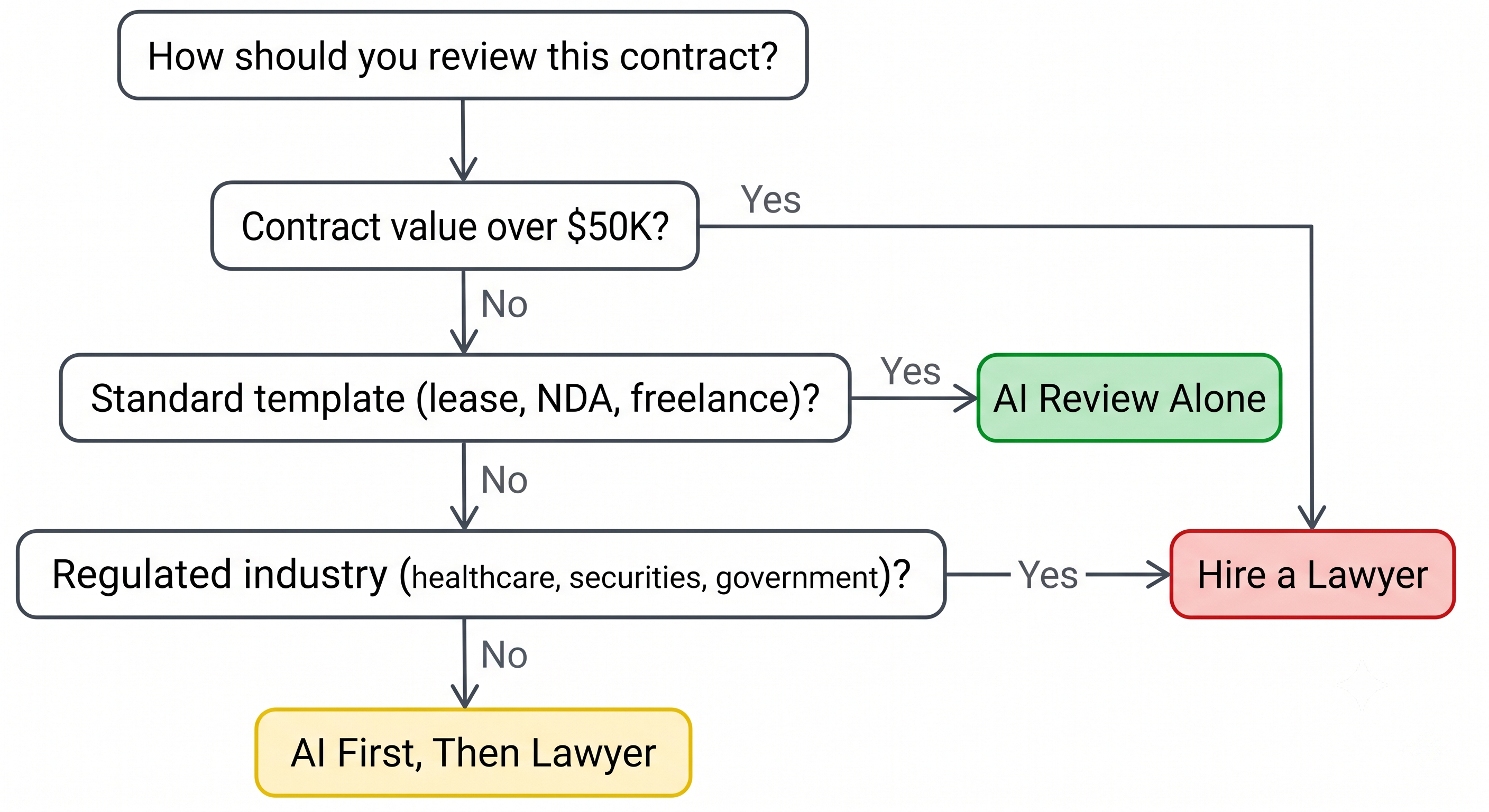
Skip the lawyer when all five of these are true:
- The contract is a standard type. NDAs, basic freelance agreements, simple residential leases, and standard vendor contracts follow predictable templates. AI tools are trained on thousands of these.
- Your financial exposure is under $10,000. If the worst-case scenario from a bad clause is less than $10K, the cost of attorney review ($350–$800) may exceed the risk.
- You need a gut check, not legal strategy. You want to know “is anything unusual in here?” rather than “how should I negotiate Section 7(b)?”
- The counterparty is using a template. If the other side sent you their standard agreement (a landlord’s lease, a client’s standard MSA, a SaaS vendor’s terms), AI is well-suited to flag deviations from market norms.
- The contract is short and straightforward. Under 15 pages, single jurisdiction, two parties, no complex contingencies.
If any one of these conditions isn’t met, move to the hybrid approach.
When You Need a Lawyer
Hire an attorney (not AI, not a hybrid approach) for these scenarios:
- Financial exposure above $50,000. Partnership agreements, commercial leases with personal guarantees, equity compensation packages, acquisition deals. The cost of legal review is a rounding error compared to what’s at stake.
- Regulated industries. Healthcare (HIPAA), finance (SEC/FINRA), government contracting (FAR), data handling (state privacy laws). Regulatory compliance adds layers AI tools aren’t designed to handle.
- Multi-party agreements. Joint ventures, syndication deals, multi-member LLC operating agreements. When three or more parties have competing interests, you need someone representing yours specifically.
- Cross-border contracts. International deals involve choice-of-law provisions, foreign jurisdiction enforcement, tax implications, and treaty considerations that require jurisdiction-specific expertise.
- Non-compete or IP assignment clauses that could affect your livelihood. Non-compete enforceability varies dramatically by state. California bans them almost entirely, while Florida enforces them broadly. An AI tool will not tell you whether yours would hold up in court.
- You expect the contract to be disputed. If you’re entering an agreement with a counterparty you don’t fully trust, or the relationship has already shown strain, lawyer involvement creates a paper trail and ensures the contract is drafted to survive litigation.
The common thread: hire a lawyer when the cost of a missed issue exceeds the cost of the lawyer by a significant multiple.
The Hybrid Approach: AI First, Lawyer Second
The hybrid approach gives you AI’s speed and cost savings on the front end and a lawyer’s judgment on the back end.
Step 1: Upload the contract to an AI review tool. Use any of the AI tools mentioned in this article: the dedicated review tools listed above, ContractCrab, Legitt AI, or even ChatGPT/Claude with a specific review prompt. Total time: 1–5 minutes. Cost: $0–5.
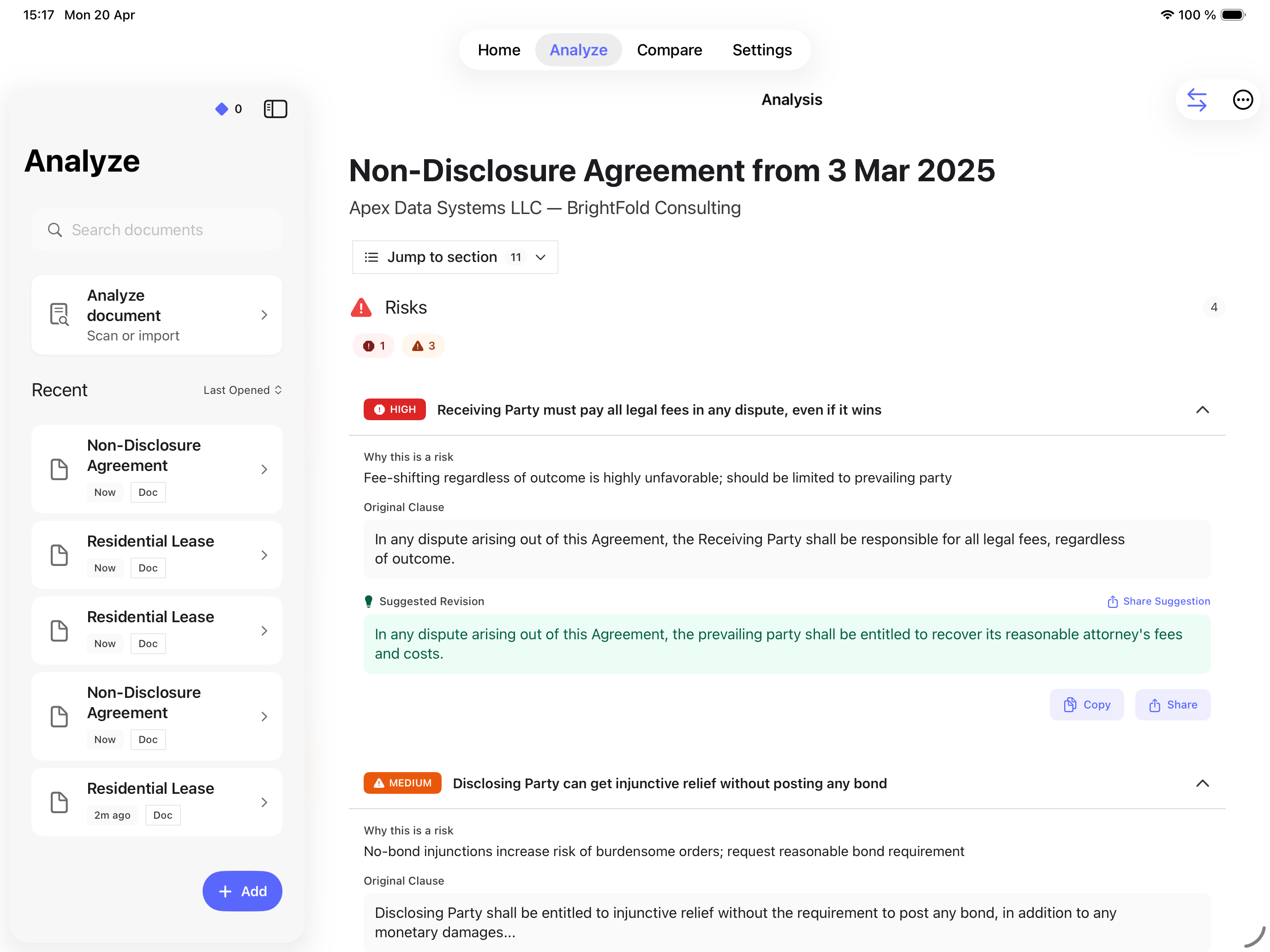
Step 2: Review the AI risk report. Read through the flagged issues. Separate them into two buckets: issues you understand and can evaluate yourself (for example, “the payment term is Net 60” and you know whether that works for you) and issues that need professional interpretation (for example, “the indemnification clause is unusually broad” and you are not sure what that means for your situation).
Step 3: Bring the flagged issues to a lawyer. Email your attorney the contract along with the AI report and your specific questions. Say: “AI flagged these three issues: the non-compete scope, the liability cap, and the missing termination clause. I need your take on these specifically.”
Step 4: The lawyer focuses on your specific issues. Instead of reading the entire contract from scratch (2–6 hours), your attorney spends 30–90 minutes on the flagged provisions. They confirm which flags are genuine problems, explain the ones that aren’t, and draft alternative language where needed.
The cost math: A full attorney review of an employment contract costs $350 to $700. The hybrid approach is AI review ($0 to $5) plus a focused 45-minute attorney consultation at $349/hour (roughly $260), totaling about $265. That is a 40 to 60 percent savings, and you still get attorney-reviewed answers on the issues that matter.
The hybrid approach works best for medium-stakes contracts: employment agreements, higher-value freelance engagements, residential leases with unusual terms, and vendor contracts with meaningful financial exposure. It gives you the thoroughness of professional review without the cost of paying a lawyer to read 12 pages of boilerplate.
The Liability Gap Nobody Talks About
This is the part most AI-vs.-lawyer comparisons skip, and it’s the part that matters most.
If a lawyer misses something: You may have a legal malpractice claim. Attorneys owe you a duty of care, a fiduciary obligation to perform competently. If your lawyer negligently fails to flag a material issue in a contract and you suffer financial harm as a result, you can sue for malpractice. Attorneys carry E&O insurance specifically to cover these claims. This does not mean you will win. You still have to prove the miss was negligent and caused actual damages. But the mechanism for accountability exists.
If AI misses something: You have essentially no recourse. Open the terms of service for any AI tool (see data privacy in legal AI) and you will find language like this: services provided “as is,” no warranty of accuracy, aggregate liability capped at fees paid (which is $0 if you used a free tier), and an explicit disclaimer that the output is not legal advice.
This isn’t a criticism of AI tools. It’s a structural reality: AI companies cannot assume liability for legal outcomes because they aren’t providing legal services. They’re providing information tools. That distinction matters less when you’re reviewing a standard NDA and more when you’re signing a partnership agreement that could make or break your business.
The practical implication: The liability gap is the reason the cost table recommends lawyers for high-stakes contracts even when AI can technically flag the same issues. You are not just paying for the review. You are paying for accountability. When a $500,000 partnership agreement goes sideways, “the AI said it looked fine” carries no legal weight. “My attorney reviewed it and missed this” at least opens a path to recovery.
This is also why the hybrid approach works: you get AI’s speed on the initial scan, but a licensed professional is accountable for the judgment calls.
Frequently Asked Questions

About Vlad Kuzin
Founder & CEO, Shepherdstack LLC
Vlad Kuzin is the founder of Shepherdstack LLC and creator of Pact, an AI-powered contract review tool. He builds software that helps individuals and small businesses understand the documents they sign.
Disclosure: Founder of Shepherdstack LLC, the company behind Pact. All comparison articles use a standardized evaluation methodology applied equally to all tools, including Pact.