
The most critical thing to understand about force majeure is that it provides relief only when events are truly beyond the parties' control, and only if your specific contract includes such a clause. Without one, you have no force majeure protection regardless of circumstances. Force majeure is a contract clause that excuses one or both parties from performing their obligations when extraordinary events beyond human control, such as natural disasters, pandemics, war, or government shutdown orders, make performance impossible or illegal.
If you've signed a commercial lease, supplier agreement, or service contract in the last decade, you almost certainly agreed to a force majeure clause. Most people skim past it. Then disaster strikes: a pandemic forces your business closed, a hurricane destroys your supplier's warehouse, or a government order makes your event illegal, and suddenly that buried clause determines whether you are protected or facing a lawsuit.
The COVID-19 pandemic triggered over a thousand federal court cases citing force majeure between 2020 and 2021. Most claimants lost. Not because their situations weren't catastrophic, but because their contracts either didn't cover pandemics specifically, or they failed to follow the clause's procedural requirements. Understanding force majeure before you need it is essential business protection, not optional.
Table of Contents
Force majeure is defined as an extraordinary event or circumstance beyond the parties' control (from the French for 'superior force') that prevents or delays contractual performance. A well-drafted force majeure clause excuses performance when events such as natural disasters, pandemics, wars, or government actions make obligations impossible or commercially impracticable. The key distinction is between force majeure events, which excuse performance entirely, and hardship, which refers to circumstances that make performance significantly more burdensome but not impossible.
- What Qualifies as Force Majeure?
- The Notification Trap
- Force Majeure vs. Act of God
- Lessons from COVID-19 Court Cases
- 5-Minute Contract Review Checklist
What Qualifies as Force Majeure?
A force majeure event is any extraordinary circumstance beyond the reasonable control of the contracting parties, including natural disasters, pandemics, wars, and government actions, that makes contractual performance impossible or impracticable.
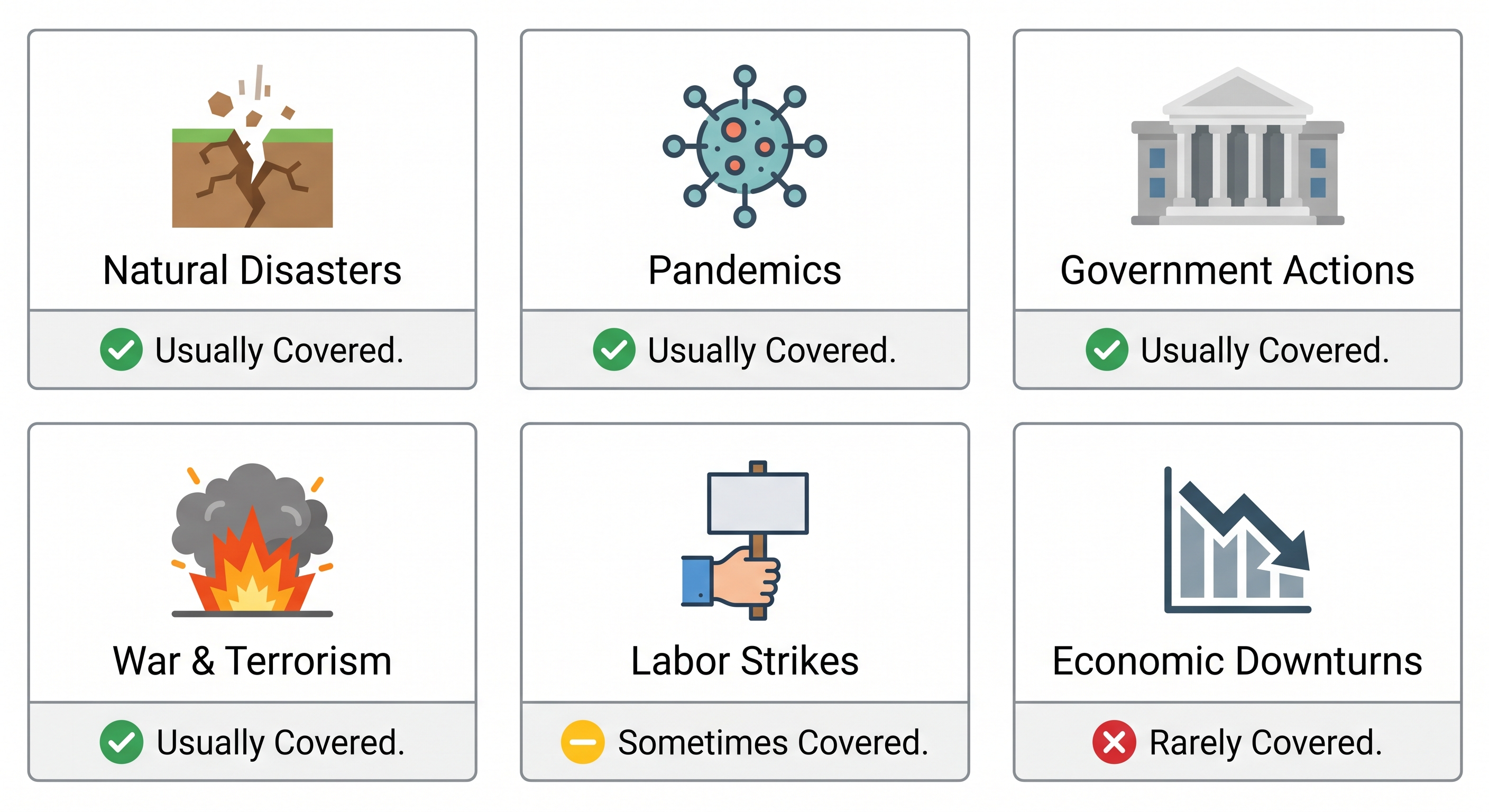
The term comes from French, meaning "superior force." Unlike what most people assume, force majeure is not an automatic legal protection. In common law countries like the United States, United Kingdom, and Australia, it only exists if your contract explicitly includes it. Here's what typically qualifies:
| Category | Examples | Usually Covered? |
|---|---|---|
| Natural Disasters | Earthquake, hurricane, flood, wildfire | Yes, if listed |
| Epidemics/Pandemics | COVID-19, future disease outbreaks | Only if specifically listed |
| Government Action | Shutdown orders, embargoes, regulatory changes | Usually |
| War/Terrorism | Armed conflict, terrorist attacks, civil unrest | Yes, if listed |
| Labor Disputes | Strikes, lockouts | Often excluded |
| Economic Events | Market crash, inflation, currency collapse | Almost never |
Critical insight: After COVID-19, pandemics are now considered "foreseeable." If your contract was signed after March 2020 and doesn't specifically list "pandemic," "epidemic," or "government-mandated closure," you may have a gap in coverage.
The Notification Trap
Here's where most force majeure claims die: the notice requirement. Most FM clauses require you to notify the other party within a specific timeframe (typically 5 to 14 days) using a specific method: written notice, email to a designated address, or certified mail. Fail to follow these requirements exactly, and courts have consistently ruled that you waive your protection entirely.
In the 2020 case Gap Inc. v. Ponte Gadea New York LLC, the retail giant stopped paying rent at its Times Square flagship during COVID. The court denied Gap's force majeure defense: not only because the clause did not specifically cover pandemics, but because proper procedures were not followed.
Before disaster strikes, know your contract's notice requirements:
- Timing: What is your notice deadline?
- Format: Written notice? Email? Certified mail?
- Recipient: Specific address or contact?
- Content: What information must the notice include?
When a qualifying event occurs, send notice immediately. Do not wait to assess the full impact. You can update the counterparty later, but you cannot retroactively fix missed notice.
Force Majeure vs. Act of God
These terms are used interchangeably, but they're legally distinct:
| Dimension | Act of God | Force Majeure |
|---|---|---|
| Scope | Natural events only | Natural AND human-caused events |
| Examples | Earthquakes, floods, hurricanes | Everything above PLUS war, terrorism, government orders, pandemics, strikes |
| Human Agency | No human involvement | Includes human-caused events beyond party control |
Why this matters: If your contract only mentions "acts of God," you are likely unprotected against pandemic-related government closures. Those involve human decisions (government orders), not purely natural events.
Best practice: A well-drafted contract should cover both: "acts of God including earthquakes, floods, and hurricanes" AND "force majeure events including government action, pandemic, war, and terrorism."
Lessons from COVID-19 Court Cases
The pandemic stress-tested force majeure clauses worldwide. Key patterns emerged: Specificity wins. In In re Hitz Restaurant Group (Bankr. N.D. Ill. 2020), a restaurant successfully obtained partial rent abatement because its lease included "governmental action" as a force majeure event. The Illinois shutdown order triggered the clause. Payment isn't performance. Courts consistently ruled that being forced to close doesn't make paying rent impossible. In Palm Springs Mile Associates, Ltd. v. Kirkland's Stores, Inc. (S.D. Fla. 2020), the court noted that the tenant failed to explain how the pandemic rendered its rental payment obligations impossible. You can still write a check from home. FM excuses the performance that became impossible, not collateral payment obligations.
Duration matters. Contracts without termination thresholds left parties in limbo. Best practice: include language allowing either party to terminate if force majeure continues beyond 60-90 days. When force majeure disputes arise, the contract's dispute resolution clauses determine whether you end up in mediation, arbitration, or court.
Beyond COVID: Emerging Force Majeure Risks
The pandemic was the stress test, but it was not the last disruption. Emerging force majeure triggers that contract drafters should address include cyberattacks (the 2021 Colonial Pipeline ransomware attack shut down fuel delivery across the U.S. East Coast for six days), extreme weather events (insured losses from natural disasters exceeded $100 billion in both 2022 and 2023 according to Swiss Re), and government sanctions (post-2022 Russia sanctions made performance impossible for thousands of cross-border contracts overnight).
Climate-related force majeure claims are rising. In the five years ending 2024, federal courts saw a 340% increase in contract disputes citing extreme weather events. The traditional "act of God" language covers hurricanes and earthquakes, but courts are split on whether record heat waves, prolonged droughts, or wildfire smoke qualify — particularly when climate models made them statistically foreseeable.
Drafting Tip: The Catch-All with Guardrails
The strongest force majeure clauses use a hybrid structure: a specific list of named events (pandemic, earthquake, government order, cyberattack, sanctions) followed by a narrow catch-all ("and other events beyond the reasonable control of the affected party that could not have been reasonably foreseen at the time of contracting"). The specific list protects against known risks. The catch-all covers the next Black Swan, but the "could not have been reasonably foreseen" qualifier prevents abuse. Without that guardrail, a party could invoke force majeure for ordinary business setbacks like supply chain delays or staffing shortages.
International Contracts: CISG vs. Common Law
Cross-border contracts face an additional layer of complexity. The UN Convention on Contracts for the International Sale of Goods (CISG Article 79) provides an automatic force majeure defense for international sales, even without a contractual clause. Under Article 79, a party is excused if failure was due to an "impediment beyond his control" that was not reasonably foreseeable. This is broader than most U.S. common law doctrines, which require impossibility rather than mere impediment. If your contract involves international parties, confirm whether CISG applies (it is the default for sales between signatory nations unless explicitly excluded) and draft your force majeure clause to address both CISG and domestic law standards.
5-Minute Contract Review Checklist
Before signing any contract, or when disaster threatens, review the force majeure clause:
-
Find it: Search for "force majeure," "act of God," "beyond control"
-
Check events: Are pandemics, government orders, and natural disasters listed?
-
Verify notice: What is the required notice format and who receives it?
-
Understand consequences: Suspension or termination? What about payments?
-
Check reciprocity: Can both parties invoke it?
Red flags: No FM clause at all, "act of God" only, one-sided protection, no pandemic language, 30+ day notice periods.
When reviewing contracts with force majeure clauses, AI-powered contract analysis tools can flag missing provisions and compare clause language against best practices in seconds, helping you catch gaps before disaster strikes.
For faster screening, AI contract review tools can flag whether a force majeure clause exists, check for common gaps like missing notification requirements, and identify whether the triggering events are broad enough to cover scenarios like pandemics or government orders.
Legal Framework
Under UCC § 2-615, a seller is excused from timely delivery of goods when performance has been made "impracticable" by the occurrence of a contingency, the non-occurrence of which was a basic assumption of the contract. This provision applies to goods transactions but courts frequently reference it by analogy in service contracts.
The Restatement (Second) of Contracts § 261 provides the broader common law rule: a party's duty to perform is discharged when that performance is made impracticable by an event whose non-occurrence was a basic assumption on which the contract was made, unless the party assumed the risk of that event.
For international contracts, CISG Article 79 provides a similar defense: a party is not liable for failure to perform if due to an "impediment beyond his control" that could not reasonably have been foreseen or avoided. Unlike U.S. law, CISG applies automatically to cross-border goods contracts unless explicitly excluded.
Conclusion
Force majeure clauses are no longer boilerplate to skim past. The pandemic proved that the exact wording of your contract, and whether you follow its notice requirements to the letter, can mean the difference between protection and catastrophic liability. Review your existing contracts now. Look for specific event coverage (especially pandemic and government orders), clear notice requirements, and termination thresholds for extended events. If your contracts are missing these elements, it's time to renegotiate before the next crisis hits.
Frequently Asked Questions

About Vlad Kuzin
Founder & CEO, Shepherdstack LLC
Vlad Kuzin is the founder of Shepherdstack LLC and creator of Pact, an AI-powered contract review tool. He builds software that helps individuals and small businesses understand the documents they sign.
Disclosure: Founder of Shepherdstack LLC, the company behind Pact. All comparison articles use a standardized evaluation methodology applied equally to all tools, including Pact.