
Startup partnerships fail most when clear written agreements on equity, IP ownership, and exit terms are missing. By the time disputes arise, the cost of resolving them typically exceeds what preventive legal work would have cost by 10 to 50 times. A partnership agreement without exit mechanisms, vesting schedules, and deadlock provisions is a legal time bomb. The statistic is sobering: 50-70% of business partnerships fail, and most fail because partners never planned for disagreement.
This isn't pessimism. It's the lesson from countless business divorces, including one that paralyzed a $165 million law firm for three years.
The $165 Million Standoff
In May 2017, Ross Cellino filed a petition to dissolve Cellino & Barnes, the Buffalo-based personal injury firm he co-founded with Steve Barnes in 1998. The firm was a juggernaut: 50 attorneys, 250 employees, over $1.5 billion in lifetime case settlements, and both partners taking home more than $1 million per month in profits.
Barnes opposed the breakup. Cellino insisted he "could no longer stand to work with Barnes" due to disagreements over personnel, finances, and marketing.
The result? A three-year legal battle. The partners couldn't amicably dissolve the firm, forcing the appointment of a referee to make binding decisions. Collateral lawsuits erupted. The firm's famous 888-8888 phone number sat unused for 18 months while courts sorted out who owned what.
The partners had no mechanism to break their deadlock. When two people each own 50% and fundamentally disagree, the company freezes until courts intervene.
The Statistics Should Terrify You
The Cellino & Barnes saga isn't an outlier. When law firm Dewey & LeBoeuf collapsed in 2012 (the largest law firm bankruptcy in U.S. history), partner disputes and governance deadlock destroyed a firm with 1,300 lawyers. Harvard Business School professor Noam Wasserman's research on over 10,000 founders found that 65% of high-potential startups fail due to co-founder conflict, not bad products or markets.
| Finding | Source |
|---|---|
| 65% of startups fail from co-founder conflict | Noam Wasserman, Harvard Business School |
| 50-70% of business partnerships fail | Multiple industry studies |
| 71% of businesses depend heavily on 1-2 key people | NAIC Small Business Survey |
| Only 22% have key person insurance | NAIC Small Business Survey |
The gap between acknowledged dependency (71%) and actual protection (22%) represents millions of businesses operating without a safety net.
Part A: The Partnership Agreement Essentials
Deadlock-Breaking Mechanisms
Every operating agreement needs a tie-breaking mechanism. Three proven options:
| Mechanism | How It Works | Best For |
|---|---|---|
| Shotgun Clause | One partner names a price; the other must buy or sell at that price | Partners who want clean, fast resolution |
| Mediation Escalation | Mandatory mediation, then binding arbitration | Partners who prefer neutral third parties |
| Tiebreaker Vote | Mutually agreed advisor casts deciding vote | Partners with trusted outside counsel |
The Shotgun Clause: Your Emergency Exit
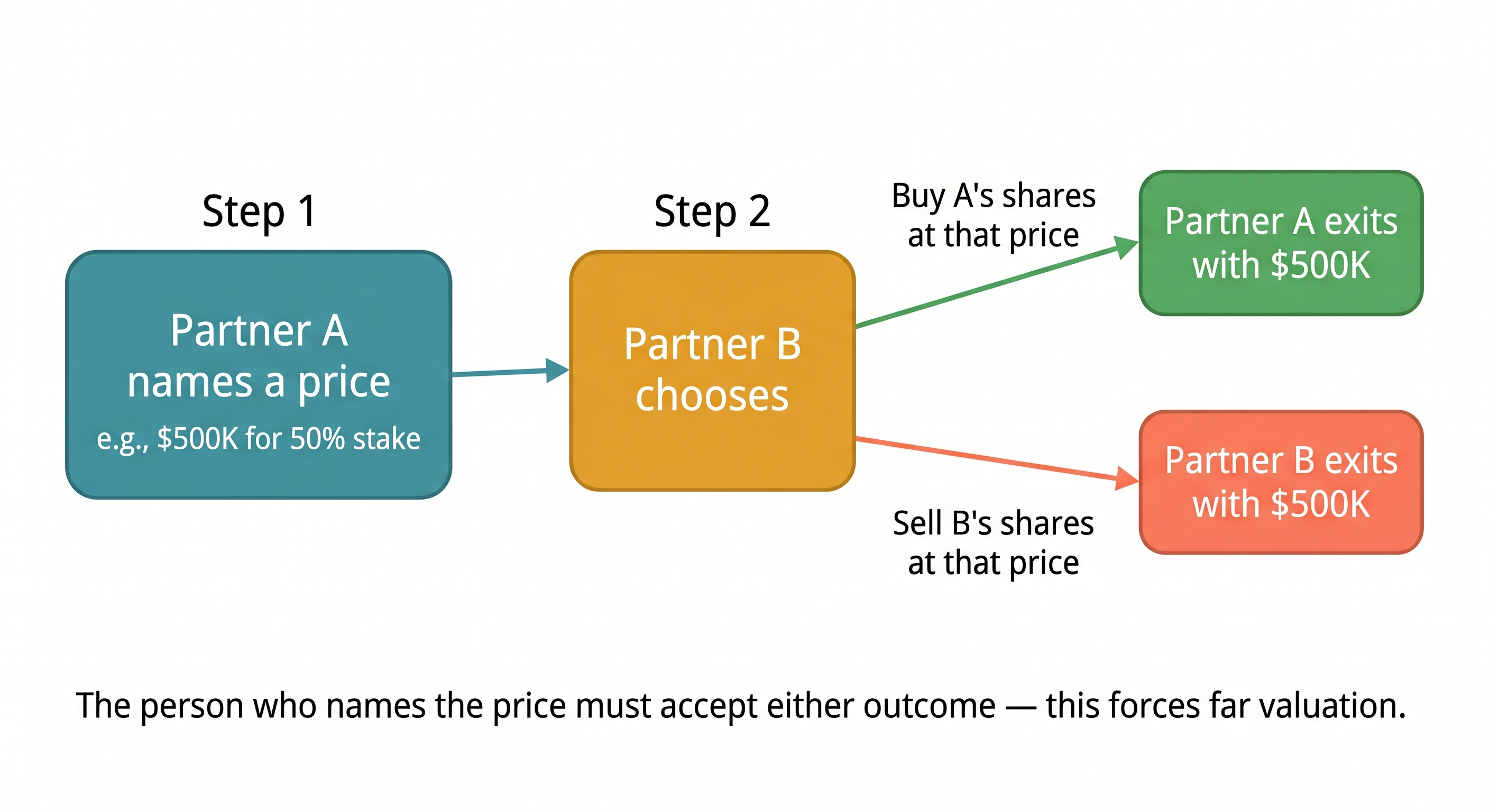
A shotgun clause (or buy-sell provision) is the business equivalent of "I cut, you choose." Here's how it works: Partner A triggers the clause, offering $X per share to buy Partner B's stake Partner B must choose: sell at that price, OR buy Partner A's shares at the same price
- One partner exits; the other gains control
Because the triggering partner doesn't know if they'll end up buying or selling, they must set a fair price. Set it too low, and you get bought out cheaply. Set it too high, and you overpay for control.
The catch: Shotgun clauses favor the wealthier party, who can more easily come up with cash. Mitigate this by allowing 60-90 days for financing and permitting assignment of buy rights to approved third parties.
Vesting Schedules: Earning Your Ownership
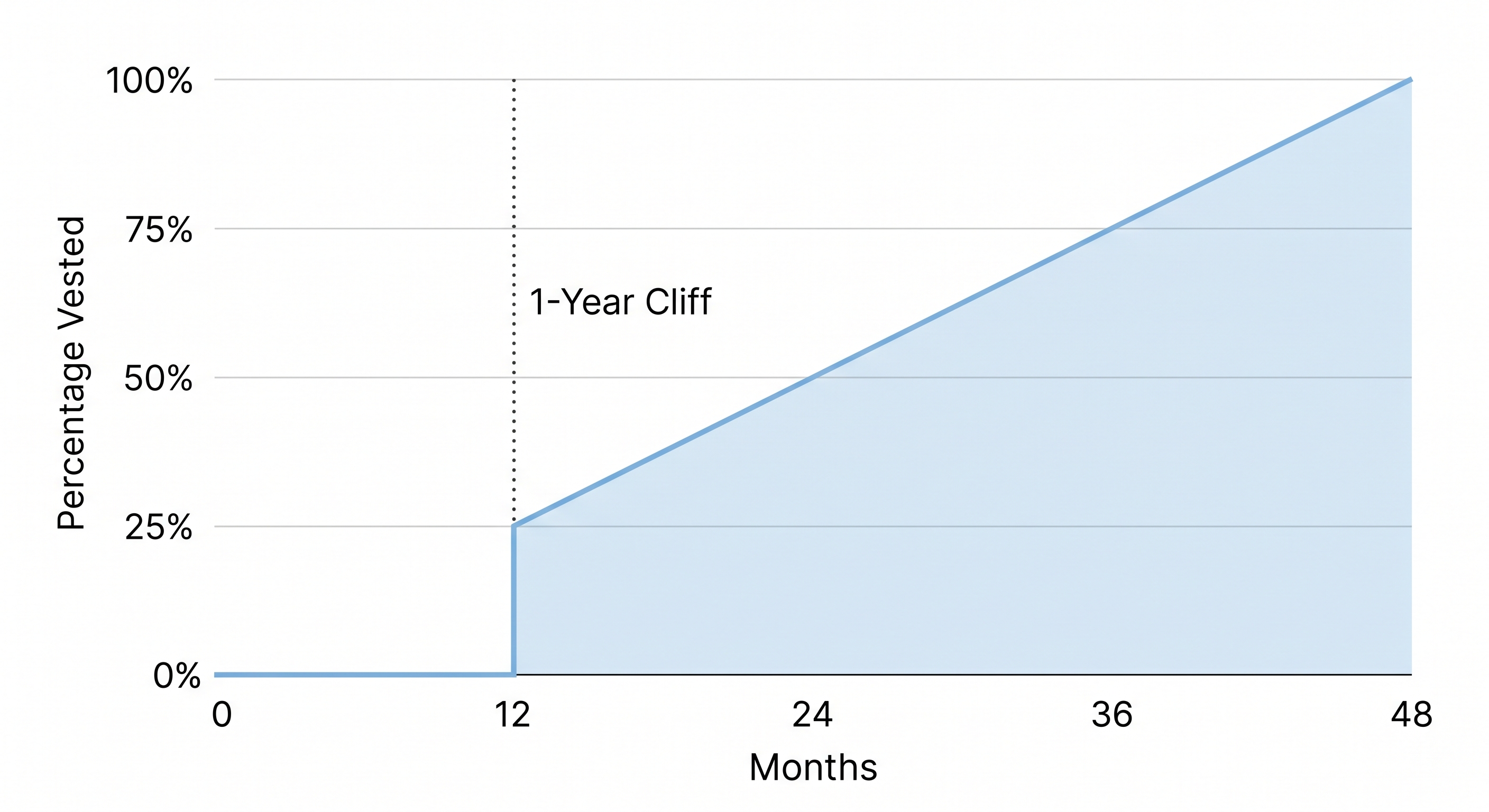
The industry standard is four-year vesting with a one-year cliff:
- Months 1-11: Nothing vests
- Month 12: 25% vests immediately
- Months 13-48: Remaining 75% vests monthly
Why does this matter? Consider this real scenario from Cooley GO: Two co-founders split equity 50/50 with no vesting. One left after 8 months to pursue another idea but kept his full stake. Investors refused to fund until the departing founder agreed to sell back shares at a cost to the remaining founder.
With a standard vesting schedule, that departing founder would have left with 0% (eight months is less than the 12-month cliff).
Consider also Snapchat's early days: Reggie Brown, one of the original co-founders who claimed to have originated the disappearing photos concept, was pushed out before proper equity structures were in place. The resulting lawsuit settled for $157.5 million, money that could have stayed in the company with clear vesting agreements.
Key Person Provisions: The "Hit by a Bus" Clause
The Social Security Administration reports that more than one in four of today's 20-year-olds will experience a disability before age 67. One in eight will die. Yet only 22% of businesses have key person insurance. Your operating agreement should specify: Automatic share conversion upon death or permanent disability Insurance proceeds that fund the buyout
- Valuation methodology for the shares
- Timeline for the transition
Without this, a deceased partner's shares may pass to family members who have no interest in running the business, or no knowledge of how to run it.
IP Ownership Between Co-Founders
The question every founding team avoids until it is too late: who owns the IP created before the company was formally incorporated? Under default copyright law, the creator owns what they create, even if they intended to contribute it to a joint venture. In Aalmuhammed v. Lee (9th Cir. 2000), the court held that contributing creative work to a collaborative project does not automatically make you a joint author or co-owner. The fix is a written IP assignment executed at or before incorporation, where each founder transfers all pre-existing and future project-related IP to the company. Without this, a departing founder can argue they own the codebase they wrote in their apartment before the company existed, and they may be right.
Part B: NDA Dangers Most People Miss
The Residuals Trap
You think you're signing a standard NDA. But buried in the fine print is a "residuals clause" that says the other party can use any "ideas, concepts, know-how, or techniques" they retain in their "unaided memory." As one startup attorney puts it: "If you see a clause captioned 'Residuals,' know that the other party is definitely trying to steal your intellectual property."
Residuals clauses appear in roughly 1 in 50 NDAs, rare enough to miss if you are not looking and devastating when present. The problem: there's no way to prove what someone does or doesn't "remember." A photographic memory, intentional memorization, or simply going home and writing notes can circumvent your entire NDA.
If you must accept one: Ensure it excludes patents and copyrights, prohibits intentional memorization, and doesn't apply to trade secrets.
The Duration Question
Most NDA confidentiality obligations should expire after 2-5 years, except for trade secrets, which should be protected indefinitely. Having no time limit can make NDAs unenforceable in certain states (Wisconsin prohibits indefinite NDAs entirely). But allowing a time limit on trade secrets can destroy their legal protection: courts have ruled that letting protection expire shows you did not take "reasonable measures" to preserve secrecy.
Best practice: Use a two-tier approach with different durations:
| Information Type | Recommended Duration |
|---|---|
| Trade secrets | Perpetual |
| Technical specifications | 3-5 years |
| Business discussions | 1-3 years |
Part C: Force Majeure After COVID-19
The pandemic stress-tested contracts worldwide, and most failed. In JN Contemporary Art LLC v. Phillips Auctioneers (2020), a federal court found COVID-19 qualifies as a "natural disaster" excusing nonperformance. But in In re CEC Entertainment (the Chuck E. Cheese bankruptcy), the court denied rent abatement under force majeure. The difference? Contract language. Courts consistently hold that force majeure relief depends entirely on what your specific clause says, not on general pandemic conditions.
Every contract you sign going forward should address:
- Explicit pandemic/epidemic language
- Government shutdown orders
- Supply chain disruptions
- Which obligations are excused (and which are not)
- Termination rights if the event persists
Legal Framework
Under the Revised Uniform Partnership Act (RUPA) § 103, adopted in most states, partners can modify most default partnership rules by agreement, but certain provisions, such as the duty of loyalty and duty of care, cannot be entirely eliminated. Without a written partnership agreement, RUPA's default rules apply, including equal profit sharing regardless of contribution.
Delaware's Limited Liability Company Act (Del. Code tit. 6, § 18-101 et seq.) provides maximum flexibility for operating agreements, making it the preferred jurisdiction for startup entity formation. However, the Delaware Chancery Court has held that implied duties of good faith and fair dealing apply even when the operating agreement is silent on specific issues.
Intellectual property assignment requires specific written agreements to be enforceable. Under 17 U.S.C. § 204(a), a transfer of copyright ownership must be in writing and signed by the owner. Without a written IP assignment clause in a founder agreement, each founder may retain ownership of IP they individually created, creating potential deadlock if a founder departs.
The most critical document for co-founders is an operating agreement with explicit buyout provisions and dissolution procedures. Partnerships without written separation terms face significantly more expensive and protracted breakups. The best time to negotiate exit terms is when the relationship is strong and all parties are aligned on the company's direction.
Defusing the Time Bomb
Before you sign your next partnership agreement, operating agreement, or NDA, consider running it through an AI contract review tool. Upload your Operating Agreement draft and get a risk analysis highlighting vague vesting language, missing deadlock-breaking mechanisms, overly broad non-competes, or weak force majeure clauses, the exact traps discussed in this article.
For the legal framework governing founder agreements, 17 U.S.C. § 204(a) requires copyright transfers to be in writing, a rule that catches early-stage startups by surprise. The Revised Uniform Partnership Act governs default partner rights in most states, and the ABA Model Rules of Professional Conduct establish the standard of care attorneys owe when drafting these agreements.
For NDAs, ask: "Does this contain a residuals clause or IP assignment language?" You think you're protecting your idea, but you might be giving it away.
For vendor contracts, check: "Can I terminate for convenience, and what's the notice period?" The answer determines whether you're locked in for a year when things go wrong.
The founder's prenup isn't about distrust. It's about building a structure strong enough to survive the disagreements that statistics say are coming.
Frequently Asked Questions

About Vlad Kuzin
Founder & CEO, Shepherdstack LLC
Vlad Kuzin is the founder of Shepherdstack LLC and creator of Pact, an AI-powered contract review tool. He builds software that helps individuals and small businesses understand the documents they sign.
Disclosure: Founder of Shepherdstack LLC, the company behind Pact. All comparison articles use a standardized evaluation methodology applied equally to all tools, including Pact.