
The most expensive lease loopholes are vague subletting clauses, undefined maintenance responsibilities, and missing holdover provisions, collectively costing U.S. tenants and landlords billions annually in avoidable disputes. The most costly lease loopholes are vague subletting clauses, undefined maintenance responsibilities, missing holdover provisions, and ambiguous pet policies. These gaps lead to an average of $2,400 to $4,800 in preventable losses annually for small landlords and create equal risks for tenants caught by unclear terms.
Whether you're a landlord protecting your investment or a tenant guarding your security deposit, lease loopholes work against everyone. According to the Joint Center for Housing Studies at Harvard, nearly half of all rental properties are owned by individual "mom and pop" landlords managing fewer than four units, people without in-house legal counsel reviewing every document. Meanwhile, surveys from Apartment List found that 72% of renters (per industry surveys) don't fully read their lease before signing.
The result? Billions of dollars in avoidable disputes every year.
This guide identifies the ten most common and most expensive lease loopholes, explains exactly why they are dangerous, and shows you how to protect yourself.
The "Sneaky Roommate" and Subletting Risks
The most common lease loopholes that cost tenants money are automatic renewal clauses with shortened notice windows, uncapped late fees, vague maintenance responsibility language, broad landlord right-of-entry provisions, and one-sided early termination penalties. We recommend reading every lease with these specific traps in mind. Catching them before signing is the best protection available.
A lease loophole is an ambiguous, missing, or poorly worded provision in a rental agreement that one party can exploit to avoid obligations or shift costs to the other party, costing tenants hundreds or thousands of dollars in unexpected charges.
Without a strict "Use of Premises" clause, tenants can move in unauthorized occupants or run short-term rental operations without landlord knowledge. Standard "no subletting" language fails to address the Airbnb era. The problem: Courts have split on whether traditional anti-subletting clauses cover platforms like Airbnb. In City of New York v. Airbnb (2020), the city required the platform to share host data, revealing thousands of lease violations. But landlords without explicit short-term rental prohibitions struggled to enforce evictions.
For a full lease review checklist covering residential and commercial terms, see our Lease Agreement Review Guide.
Pet Policy Ambiguities
A simple "No Pets" clause creates more problems than it solves, primarily because it ignores the legal distinction between pets, service animals, and emotional support animals (ESAs). Under the Fair Housing Act, ESAs are not pets. Landlords cannot charge pet deposits for ESAs, apply breed restrictions, or deny accommodation with proper documentation. HUD processed over 16,000 fair housing complaints in FY 2022, with assistance animal disputes among the most common.
| Category | Legal Status | Landlord Rights |
|---|---|---|
| Pets | Property, no special protections | Can prohibit entirely, charge deposits, set breed restrictions |
| Service Animals (ADA) | Not pets; required for disability | Cannot charge deposit, cannot deny, cannot require documentation beyond basic verification |
| Emotional Support Animals (FHA) | Not pets; reasonable accommodation | Cannot charge pet deposit, can request documentation from healthcare provider |
The problem: Landlords who deny ESAs face discrimination complaints. Conversely, tenants with questionable ESA documentation can cause property damage landlords cannot recover because no pet deposit was collected.
The fix: Address assistance animals explicitly. Your lease should state that pet policies don't apply to service or emotional support animals and provide a clear process for tenants to request accommodation.
Maintenance & Repair: Who Pays?
This is the most frequent friction point between landlords and tenants. The dispute usually is not about major systems (everyone agrees the landlord handles a broken furnace) but about the gray areas.
| Repair Category | Common Dispute | Resolution |
|---|---|---|
| Clogged drains | Misuse vs. normal use | Define "misuse" with examples |
| Appliance failures | User error vs. normal wear | Specify who handles minor vs. major repairs |
| HVAC issues | Maintenance vs. damage | Assign filter replacement responsibility |
| Pest control | Infestation vs. prevention | Set thresholds for landlord responsibility |
The problem: Clauses like "Tenant responsible for minor repairs" or "Tenant pays first $100 of any repair" create perverse incentives. Tenants delay reporting problems until they exceed the threshold. "Minor" is never defined, inviting arguments.
The fix: List specific examples. Assign HVAC filter replacement, light bulb changes, and drain care to tenants. Define "damage from misuse" concretely. Avoid arbitrary dollar thresholds.
The Holdover Tenant Trap
When a lease expires but the tenant stays, what happens? Without a holdover clause, most states convert the arrangement to month-to-month tenancy at the existing rent. If you've already signed a new tenant starting the following month, you're now facing eviction proceedings that can take 2-6 months. According to TransUnion Rental Screening Solutions, the average eviction takes 3.5 months and costs $3,500 in legal fees and lost rent.
The fix: Include a holdover clause specifying that unauthorized remaining triggers rent at 150-200% of the standard rate, prorated daily, plus liability for any damages including lost income from prospective tenants.
6 More Loopholes You're Probably Missing
Security Deposit Deduction Disputes
States like California require itemized statements within 21 days. Leases silent on walkthrough procedures, photo documentation, or deduction categories invite small claims battles.
Rent Escalation Without Limits
"Rent may increase annually" says nothing about how much. Specify calculation methods, cap percentages, and notice requirements.
Early Termination Traps
"Tenant liable for rent through end of term" may be unenforceable where landlords must mitigate damages. Specify reasonable termination fees and re-renting obligations.
Auto-Renewal Snares
Short opt-out windows trap both parties. Require mutual opt-in rather than silent renewal.
Unenforceable Late Fees
"$50/day" late fees may be struck down as penalties rather than legitimate liquidated damages. Flat fees of $25-75 tied to actual administrative costs hold up better.
Right of Entry Violations
"Landlord may enter at any time" violates tenant quiet enjoyment rights. Most states require 24-48 hours notice except for emergencies.
The Cost of Each Loophole: A Dollar Breakdown
Not all loopholes carry equal financial risk. Based on small claims court data and tenant advocacy reports, here is the approximate cost exposure for each of the ten loopholes covered in this guide, assuming a $2,000/month residential lease or a $5,000/month commercial lease:
Unauthorized subletting disputes: $3,000-$8,000 in legal fees and lost rent. Pet policy violations: $500-$5,000 in damage claims and ESA accommodation disputes. Maintenance ambiguity: $1,200-$15,000 over a three-year term depending on what repairs shift to the tenant. Holdover penalties: $4,000-$10,000 per month at 150-200% of standard rent. Security deposit deductions: $1,000-$6,000 in contested charges. Uncapped rent escalation: $2,400-$12,000 per year above market rate. Early termination exposure: $6,000-$60,000 (remaining lease balance). Auto-renewal traps: $12,000-$60,000 (full additional term at current rent). Excessive late fees: $1,200-$4,800 per year in penalty accumulation. Unauthorized landlord entry: $1,000-$10,000 in privacy violation claims.
The total exposure from a lease with all ten loopholes active ranges from $32,000 to over $190,000. Catching even two or three of these during pre-signing review pays for years of legal technology.
Commercial tenants face even steeper exposure. A triple-net lease with uncapped CAM charges, an unlimited personal guarantee, and a broad relocation clause can generate six-figure liability from a single lease term. The National Association of Realtors reports that commercial lease disputes average $28,000 in legal fees alone, before any settlement or judgment.
How AI Lease Review Closes These Gaps
The math doesn't work for traditional review: 15-page leases require 2-4 hours of careful reading, legal knowledge most people don't have, and attorney fees of $200-500 per document. AI-powered contract review changes this equation:
-
Gap detection flags missing protective clauses automatically
-
Ambiguity alerts identify vague language before it becomes a dispute
-
State compliance checks verify jurisdiction-specific requirements
-
Plain English translation explains complex terms without a law degree
-
Risk scoring prioritizes the most dangerous provisions
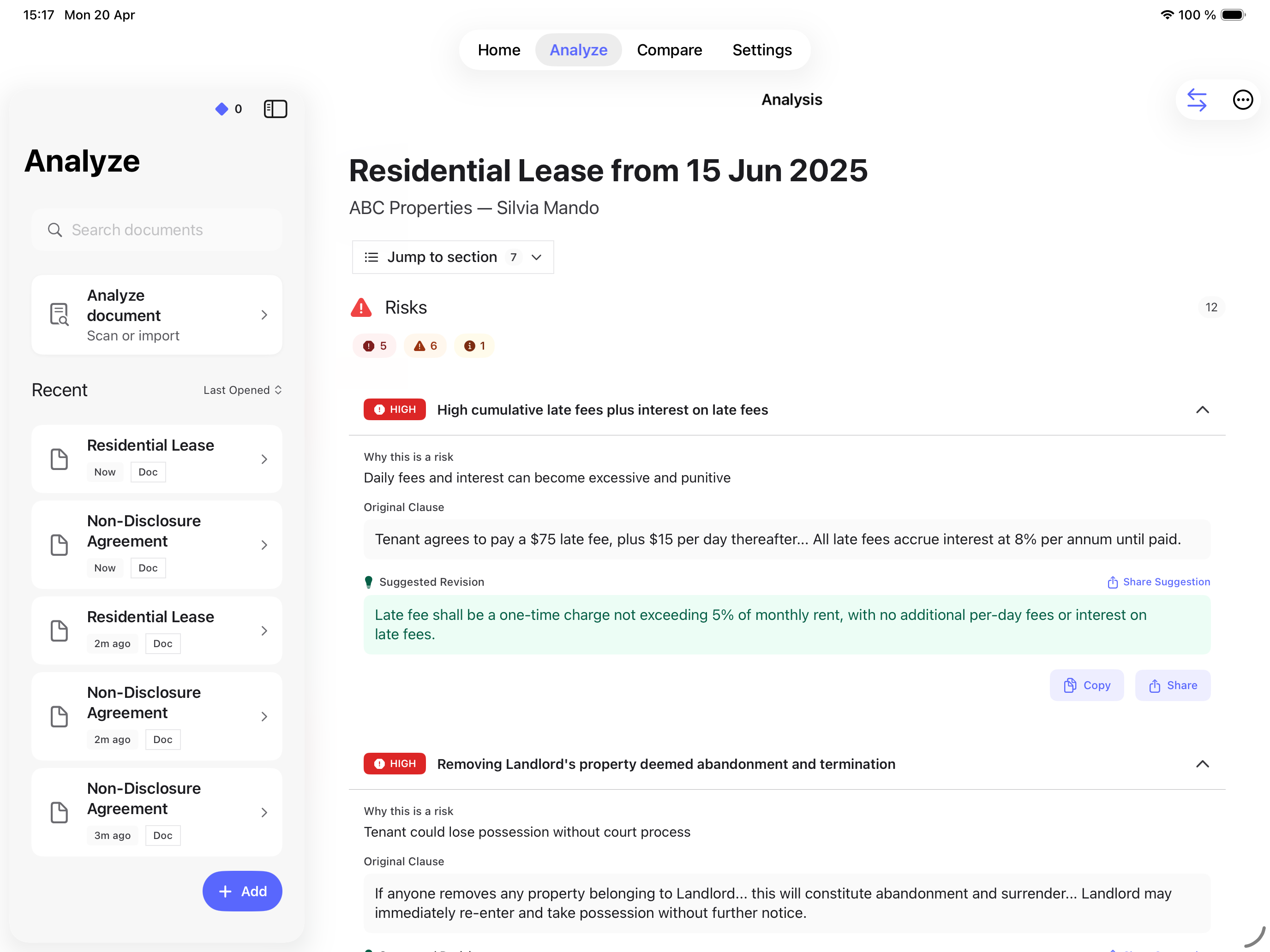
For SMB owners reviewing commercial leases, freelancers signing studio agreements, or landlords managing their own properties, automated review delivers attorney-level scrutiny at a fraction of the cost and time.
Contract Analyze by Pact AI (reviewed on this blog), Legitt AI, or ChatGPT perform these checks. Upload your lease and get a risk-scored report highlighting missing clauses, ambiguous language, and unenforceable terms in seconds.
Your Lease Loophole Checklist
Before signing or issuing any lease, verify these provisions exist and are specific: Subletting and short-term rental prohibitions with defined terms Pet policy with ESA/service animal accommodation process Maintenance responsibilities with specific examples
- Holdover clause with increased rent provision
- Security deposit procedures matching state law
- Rent escalation caps and calculation methods
- Early termination terms and mitigation obligations
- Renewal notice requirements for both parties
- Late fees within enforceable ranges
- Entry notice requirements and emergency definitions
Every gap represents potential thousands of dollars in disputes. The cost of getting it right upfront (whether through careful manual review or AI-assisted analysis) is always less than the cost of litigation later.
Key Legal Framework
The Fair Housing Act (42 U.S.C. § 3604) prohibits discrimination in housing, including pet policies that fail to accommodate service animals and emotional support animals. Under HUD's 2020 guidance, landlords who deny reasonable accommodation requests face fines of up to $21,039 for a first offense.
Security deposit laws vary significantly by state. California Civil Code § 1950.5 limits deposits to two months' rent for unfurnished units and requires itemized deductions within 21 days. New York General Obligations Law § 7-108 limits deposits to one month's rent statewide. Texas Property Code § 92.103 requires return within 30 days.
Late fee enforceability depends on state law. Most jurisdictions apply the "liquidated damages" test under Restatement (Second) of Contracts § 356: fees must be a reasonable estimate of actual damages, not a penalty. Fees exceeding 5-10% of monthly rent are frequently struck down as unenforceable penalties.
Legal Sources & References
Frequently Asked Questions

About Vlad Kuzin
Founder & CEO, Shepherdstack LLC
Vlad Kuzin is the founder of Shepherdstack LLC and creator of Pact, an AI-powered contract review tool. He builds software that helps individuals and small businesses understand the documents they sign.
Disclosure: Founder of Shepherdstack LLC, the company behind Pact. All comparison articles use a standardized evaluation methodology applied equally to all tools, including Pact.