
The most important NDA principle is mutuality: the best non-disclosure agreements protect both parties equally, with clearly defined confidential information, reasonable time limits, and specific carve-outs for information that becomes public or was independently developed. An NDA protects confidential information only when three elements are properly defined: what counts as confidential, how long the obligation lasts, and what standard exclusions apply. Miss any of these, and your NDA may be either unenforceable or a liability trap.
If you're a small business owner, freelancer, or landlord who signs contracts regularly, this guide will show you how to evaluate any NDA in about five minutes, no law degree required. For founders entering business partnerships, NDAs in partnerships carry additional considerations around shared IP and exit scenarios.
Table of Contents
The key to a well-drafted NDA is balancing confidentiality protection with practical enforceability. The most important provisions to negotiate are the definition and scope of confidential information, standard exclusions for prior knowledge and publicly available information, the duration of confidentiality obligations, and the remedies available in the event of a breach.
- Why NDAs Matter More Than Ever
- The Three Pillars of Every NDA
- Pillar 1: Definition of Confidential Information
- Pillar 2: Duration and Term
- Pillar 3: The Standard Exclusions
- The 5-Minute NDA Checklist
- Frequently Asked Questions
- Sources
Why NDAs Matter More Than Ever
Non-disclosure agreements are everywhere. Research suggests that between 33% and 57% of U.S. workers are bound by an NDA or similar confidentiality mechanism. For business owners, the stakes are even higher, as you are likely both signing and issuing these agreements regularly. The consequences of getting NDAs wrong can be severe. In 2018, Waymo (Google's self-driving car division) settled a trade secret lawsuit against Uber for $245 million after a former engineer allegedly took 14,000 confidential files to a competitor. In another case, a company won a $123 million verdict purely on NDA breach claims when the trade secret statute of limitations had expired.
According to Lex Machina's 2024 Trade Secret Litigation Report, 1,203 trade secret cases were filed in federal courts in 2023 alone. And when these cases go to trial, plaintiffs win approximately 81% of the time.
Yet most people sign NDAs without reading them carefully. The problem is not laziness. NDAs seem impenetrable: they are written at a 14th-grade reading level, filled with legal jargon that obscures what actually matters.
The key reframe: You do not need to understand every clause. You need to evaluate three pillars.
The Three Pillars of Every NDA
We recommend that every NDA include five essential components: a precise definition of what constitutes confidential information, clear exclusions for information already known or publicly available, a reasonable duration that balances protection with practicality, specific permitted disclosures such as those required by law, and well-defined remedies for breach including injunctive relief. The best NDAs also address what happens to confidential materials when the agreement expires, requiring return or destruction of all copies within a defined timeframe.
Every NDA, regardless of length or complexity, answers three fundamental questions:
| Pillar | The Question | Red Flag If... |
|---|---|---|
| WHAT | What counts as confidential? | Definition is vague ("all information exchanged") |
| HOW LONG | How long must I keep it secret? | Duration is perpetual for ordinary business information |
| WHAT'S EXCLUDED | What am I NOT responsible for? | Standard exclusions are missing |
Master these three areas, and you can evaluate any NDA confidently.
Pillar 1: Definition of Confidential Information
The most dangerous clause in any NDA is an overly broad definition of confidential information. If "everything we discuss" is confidential, you're setting yourself up for accidental breach. What to look for:
| Definition Type | Example Language | Risk Level |
|---|---|---|
| Over-broad | "Any and all information disclosed" | High |
| Reasonable | "Information marked 'Confidential' or disclosed in circumstances indicating confidentiality" | Low |
| Narrow | "Only information listed in Exhibit A" | Medium |
The gold standard is a "marked or circumstances" definition. This means written information must be labeled as confidential, while oral disclosures must be identified as confidential at the time of disclosure (and confirmed in writing within a set period, like 30 days).
Warning signs:
- No marking requirement for written materials
- "Including but not limited to..." followed by vague categories
- Coverage of "ideas," "concepts," or "general skills and knowledge"
Tools like Contract Analyze by Pact AI (reviewed on this blog), Legitt AI, or ChatGPT can flag overly broad definitions automatically, highlighting exactly where the language creates risk.
Pillar 2: Duration and Term
How long must you keep information confidential? The answer depends entirely on the type of information.
| Information Type | Appropriate Duration | Why |
|---|---|---|
| True trade secrets | Perpetual (valid) | Secrets retain value indefinitely |
| Business strategies | 2-5 years | Strategies become obsolete |
| Customer lists | 2-3 years | Relationships naturally evolve |
| Pricing information | 1-2 years | Markets change rapidly |
The perpetual NDA trap: Courts generally enforce perpetual confidentiality only for genuine trade secrets. If an NDA demands perpetual secrecy for ordinary business information, it may be unenforceable, though fighting that in court is expensive.
According to legal analysis from BlueInk, most NDAs appropriately last between one and five years, with perpetual terms reserved exclusively for information that qualifies as a trade secret under law.
What to negotiate: If you see "perpetual" or "indefinite" terms applied to all information, push back: "Confidentiality obligations shall survive for three (3) years following disclosure, except that obligations regarding trade secrets shall continue for as long as such information remains a trade secret."
Pillar 3: The Standard Exclusions
Every enforceable NDA should exclude four categories of information from confidentiality obligations. These are so standard that missing exclusions are an immediate red flag.
| Exclusion | What It Protects | Risk If Missing |
|---|---|---|
| Prior Knowledge | Information you already knew before signing | You're liable for your own pre-existing knowledge |
| Public Domain | Information that becomes publicly available (not through your breach) | You're responsible for information anyone can Google |
| Independent Development | Information you create on your own | Your innovations could be claimed as derivative |
| Legal Compulsion | Information you must disclose by law or court order | You face contempt of court to honor the NDA |
As FasterCapital's analysis notes, these exclusions "help maintain a fair balance between protecting confidential information and recognizing existing knowledge or publicly accessible data."
If an NDA lacks these four exclusions, it's either poorly drafted by someone unfamiliar with standard practice, or it's intentionally overreaching. Either way, request that standard carve-outs be added before signing.
The 5-Minute NDA Checklist
Use this checklist to triage any NDA quickly: Definition of Confidential Information: Is there a specific, bounded definition? Is marking required for written materials?
- Are oral disclosures required to be confirmed in writing?
Duration:
- Is there a stated term (not just "perpetual")?
- Is perpetual protection limited to true trade secrets?
- When does the clock start: signing or each disclosure?
Exclusions (all four must be present):
- Prior knowledge
- Publicly available information
- Independently developed information
- Legally compelled disclosure
Consequences:
- What remedies are available (injunction, damages)?
- Who pays attorney fees if there's a dispute?
- Is there a damages cap or limitation? (See our guide on limitation of liability clauses for what to look for.)
Jurisdiction:
- Which state's law governs?
- Where must disputes be filed?
- Is arbitration required?
For a faster check, upload the NDA to Contract Analyze or ChatGPT. Either tool evaluates all five checklist areas and flags missing exclusions, overly broad definitions, and one-sided terms in seconds.
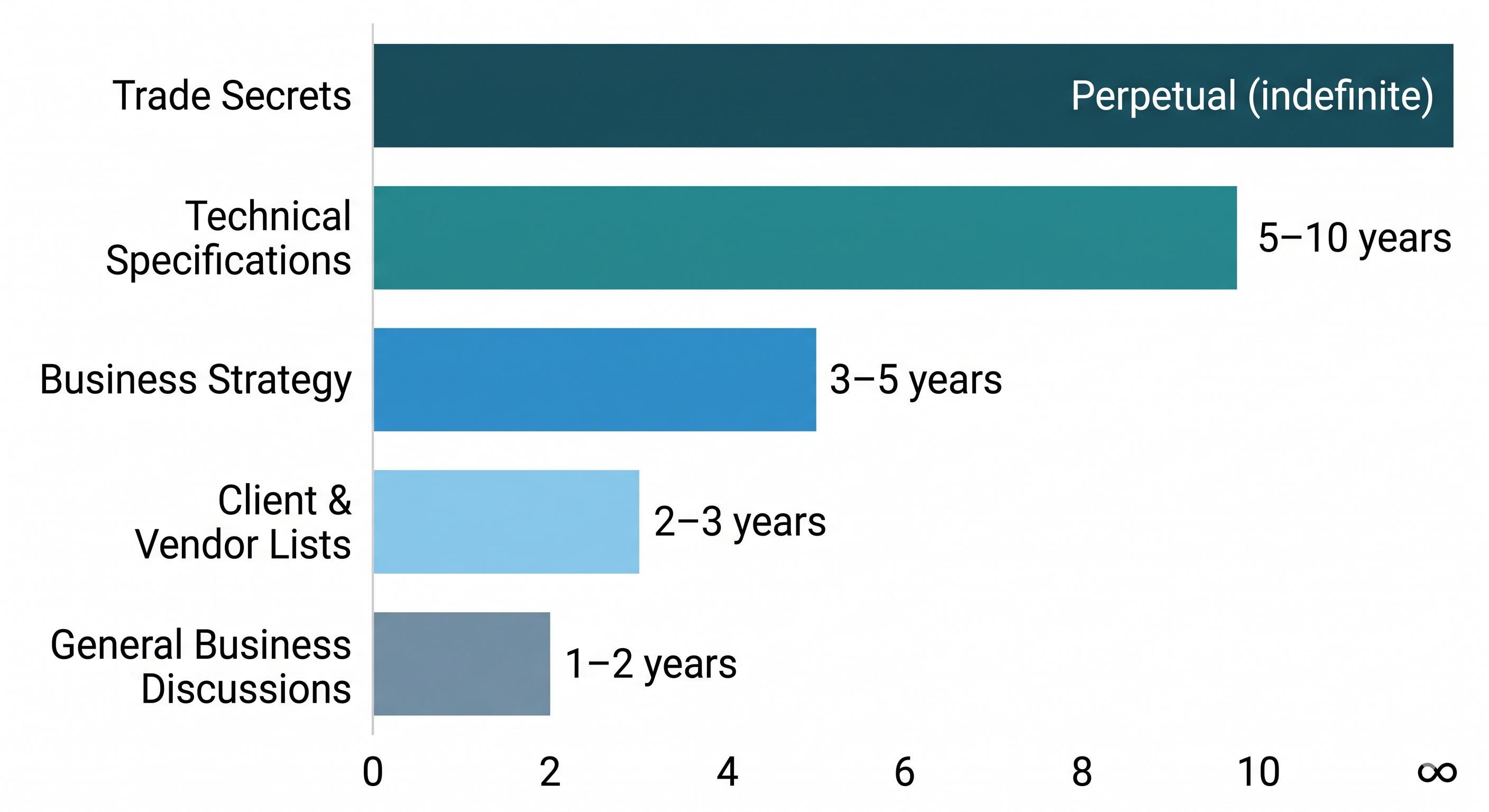
Typical NDA duration by information type: trade secrets warrant indefinite protection, source code and proprietary algorithms warrant 5-10 years, business strategies and financial data warrant 3-5 years, client lists and pricing information warrant 2-3 years, and general business discussions warrant 1-2 years. If your NDA applies a single duration to all categories, you are either overprotecting routine information (making enforcement harder) or underprotecting trade secrets (creating a legal argument that you did not take "reasonable measures" to preserve secrecy, which is the threshold under the Defend Trade Secrets Act).
Frequently Asked Questions

About Vlad Kuzin
Founder & CEO, Shepherdstack LLC
Vlad Kuzin is the founder of Shepherdstack LLC and creator of Pact, an AI-powered contract review tool. He builds software that helps individuals and small businesses understand the documents they sign.
Disclosure: Founder of Shepherdstack LLC, the company behind Pact. All comparison articles use a standardized evaluation methodology applied equally to all tools, including Pact.