
Yes, you can trust AI with legal documents if you can answer three questions. Where does your document go? Does anyone train on it? Who makes the final decision? The difference between safe and risky AI comes down to architecture: where your document goes, who can see it, and what happens to it afterward.
Table of Contents
- Why This Question Matters Now
- The Real Risks: What Can Go Wrong
- What the Law Says About AI and Confidentiality
- How to Evaluate AI Document Security
- Privacy-First Architecture: A Different Approach
- Human-in-the-Loop: Why It Matters
- What to Look For in a Legal AI Tool
- FAQ
Why This Question Matters Now
Legal document handling is under siege. According to industry data from 2024, 40% of law firms have experienced a security breach, and the average cost of a data breach in the legal sector reached $5.08 million. Ransomware attacks on law firms hit a record 45 incidents in 2024 alone, compromising 1.5 million records.
These aren't just statistics for large firms. Every contract you review, every lease you sign, every NDA you negotiate contains information that could damage your business if exposed. And as AI tools promise to make document review faster and easier, a critical question emerges: are you trading security for convenience?
The Real Risks: What Can Go Wrong
In April 2023, Samsung learned this lesson the hard way. Just weeks after allowing employees to use ChatGPT, three separate data leaks occurred. Engineers copied proprietary semiconductor source code into the chatbot seeking debugging help. Another employee uploaded meeting recordings to generate minutes. The problem? That data became part of OpenAI's training set.
Samsung banned ChatGPT company-wide, extending the prohibition to all generative AI tools. An internal survey revealed that 65% of Samsung employees recognized AI security risks, but only after the damage was done.
Now imagine uploading a contract containing your negotiated pricing, a settlement agreement with confidential terms, or a lease with your tenants' personal information. With free AI tools that train on user inputs, that data doesn't just disappear.
What the Law Says About AI and Confidentiality
The legal profession is taking notice. In July 2024, the American Bar Association issued Formal Opinion 512, its first formal ethics guidance on generative AI. The opinion warns that inputting confidential information into public AI platforms "may constitute disclosure to a third party," potentially waiving attorney-client privilege. For non-lawyers, the principle still applies: when you upload a document to a free AI tool, you may be sharing it with a third party whose terms of service allow them to retain, analyze, and learn from your data.
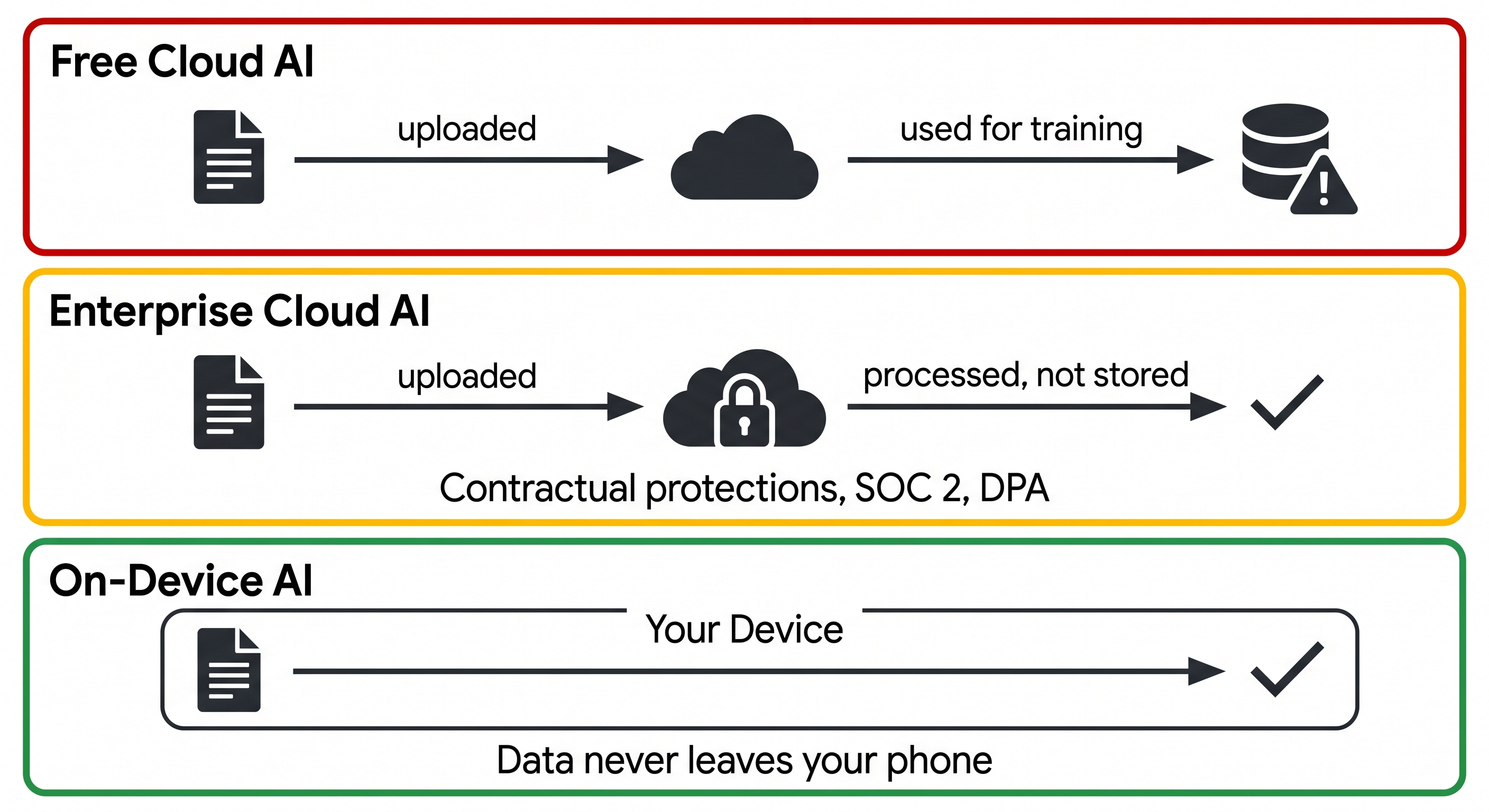
| AI Service Tier | Trains on Your Data? | Data Retention | Your Control |
|---|---|---|---|
| Free AI Tools | Yes (default) | Up to 30 days | Limited |
| Enterprise AI | No (contractual) | Admin-controlled | Moderate |
| On-Device AI | No (architectural) | Device only | Full |
How to Evaluate AI Document Security
Not all AI is created equal. The key question is not whether to use AI, but which architecture protects your information.
Step 1: Understand Where Your Document Goes
Cloud-first AI tools upload your document to remote servers for processing. Even with privacy promises, your data travels outside your control. On-device AI processes documents locally, meaning sensitive content never leaves your phone or computer.
Step 2: Check the Training Policy
OpenAI's privacy documentation states that ChatGPT Free and Plus use your inputs for training by default (you can opt out). Enterprise tiers contractually exclude your data from training. On-device tools have no access to your data in the first place.
Step 3: Verify Data Retention
Even if a company doesn't train on your data, how long do they keep it? Free tools may retain data for 30 days or more. On-device tools retain nothing beyond your own device storage.
Step 4: Evaluate the Ecosystem
Tools built within established security ecosystems inherit those protections. Apple's architecture, for example, uses AES-256 encryption at rest and TLS 1.2+ in transit. Advanced Data Protection extends end-to-end encryption to 23 data categories, meaning even Apple cannot access your information.
Privacy-First Architecture: A Different Approach
The most secure AI tools are designed with privacy as a foundation, not an afterthought. This means:
Processing you can see: The safest design analyzes documents on the device itself. When a tool sends text to a cloud AI model, it should say so and ask first.
Short server retention: Content sent for analysis should be deleted within hours or days, not kept indefinitely.
Storage you control: Saved analyses should live on your device or in your own cloud account. Apple's Advanced Data Protection lets you hold the iCloud encryption keys.
No training on user data: The tool and any AI provider it uses should state in writing that your documents are not used to train models.
Calculating Your Risk Exposure
The cost of an AI data breach scales with the sensitivity of your documents. A leaked NDA may damage a business relationship. A leaked M&A term sheet can move stock prices and trigger SEC investigations. A leaked employment settlement can violate court-ordered confidentiality and expose you to contempt sanctions.
Here is a practical risk framework: For documents with financial exposure under $10,000 (standard NDAs, routine vendor agreements), free AI tools with opt-out data training provide acceptable risk. For documents with exposure between $10,000 and $100,000 (commercial leases, employment contracts, partnership agreements), use tools with on-device processing or enterprise-grade encryption. For documents with exposure above $100,000 (M&A agreements, investor term sheets, settlement agreements), use on-device tools only, or have your attorney review manually. The five minutes spent choosing the right tool is cheap insurance. IBM's 2026 report puts the global average cost of a data breach at $4.99 million.
One risk that receives insufficient attention: metadata leakage. Word documents and PDFs contain hidden metadata including author names, revision history, tracked changes, and internal comments. Uploading a document with metadata intact to a cloud AI tool exposes not just the contract text but your negotiation history and internal deliberations. Strip metadata before uploading to any cloud service. On Mac, use Preview’s Export function; on Windows, use File > Info > Check for Issues > Inspect Document.
Human-in-the-Loop: Why It Matters
The most trustworthy AI tools acknowledge what they can't do. AI excels at pattern recognition: flagging unusual clauses, highlighting potential risks, comparing language to standard terms. But understanding your specific business context, assessing acceptable risk levels, and making final decisions requires human judgment. This is why the best legal AI positions itself as a "review assistant," not a replacement for professional advice. It highlights issues for your consideration. You decide what matters.
This transparency is both ethical and practical. A tool that claims to do everything is a tool you cannot verify. A tool that clearly states its role helps you use it appropriately.
What to Look For in a Legal AI Tool
Before trusting any AI with your documents, verify these five criteria:
| Criterion | Why It Matters | What to Check |
|---|---|---|
| On-device processing | Your document stays in your control | Does the privacy policy mention local/on-device processing? |
| No training on data | Your information won't help competitors | Look for explicit statements about not using customer data for training |
| Established ecosystem | Inherits proven security | Apple ecosystem, SOC 2 certified infrastructure |
| Clear limitations | Honest about what AI can't do | Does it recommend professional review for important matters? |
| User data control | You can delete everything | Is there a clear process to remove your data? |
For contracts, leases, and NDAs, Pact sends your document through its servers to a third-party AI provider. It asks your permission before the first send. Its servers delete analysis data within 48 hours. Under the provider's terms, your content is not used for training and may be kept up to 30 days to monitor abuse. Your saved analyses stay on your device and in your own iCloud. To understand how AI review works under the hood, see our technical explainer. And for a list of contracts AI should not review alone, see our risk guide.
Legal Framework
The General Data Protection Regulation (GDPR) Article 6 requires a lawful basis for processing personal data. When uploading contracts containing personal information to AI tools, the processing must be justified under one of six legal bases, most commonly legitimate interest (Article 6(1)(f)) or consent (Article 6(1)(a)). Article 28 further requires data processing agreements with any third-party processor.
The California Consumer Privacy Act (CCPA, Cal. Civ. Code § 1798.100) gives consumers the right to know what personal information is collected, request deletion, and opt out of the sale of personal data. AI tools processing contracts that contain California residents' personal information must comply with CCPA requirements, including providing a conspicuous "Do Not Sell My Personal Information" link.
The EU AI Act (Regulation 2024/1689) entered into force on August 1, 2024, and classifies AI systems by risk level. Its obligations apply in stages. AI that assists courts or arbitrators in interpreting and applying the law is "high-risk" under Annex III. High-risk systems need human oversight, risk management, and detailed technical documentation. The 2026 Digital Omnibus (Regulation 2026/1744) moved those Annex III obligations to December 2, 2027.
Frequently Asked Questions

About Vlad Kuzin
Founder & CEO, Shepherdstack LLC
Vlad Kuzin is the founder of Shepherdstack LLC and creator of Pact, an AI-powered contract review tool. He builds software that helps individuals and small businesses understand the documents they sign.
Disclosure: Founder of Shepherdstack LLC, the company behind Pact. All comparison articles use a standardized evaluation methodology applied equally to all tools, including Pact.