
The Non-Compete Clause: What It Restricts and When Courts Enforce It
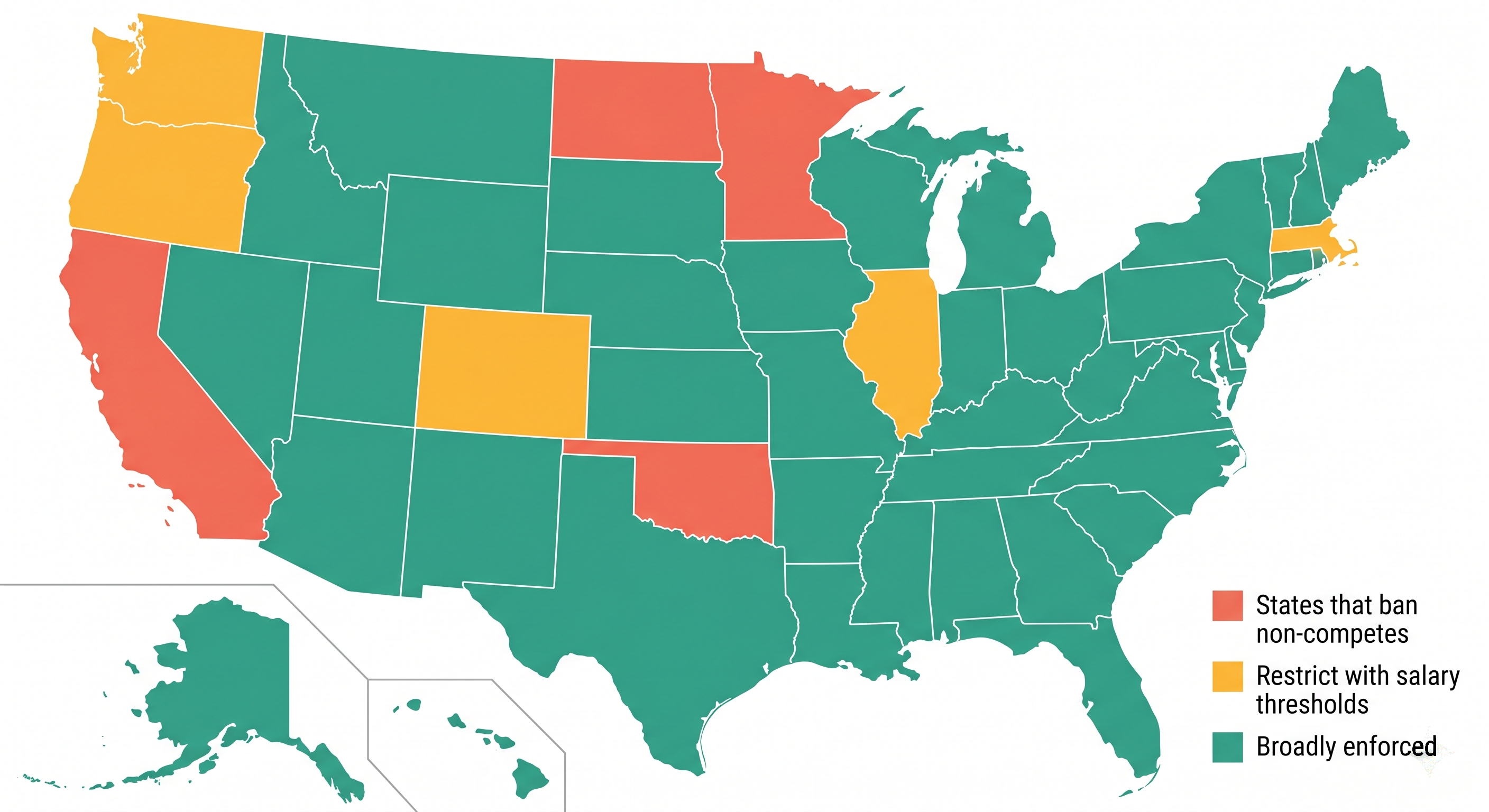
A non-compete clause is a contract provision that bars you from working for a competitor or starting a competing business for a defined period after your current employment or contract ends. The FTC estimated in its 2024 rulemaking that roughly 30 million American workers (about one in five) are bound by one. Despite that prevalence, non-competes are fully banned in four states, restricted by salary thresholds in at least six more, and routinely voided by courts when they overreach on time, geography, or scope.
What a Non-Compete Clause Does
A non-compete imposes three restrictions, each bounded by specific terms in the contract:
1. Who you can work for. The clause defines competitors by company name, by industry, or by description ("any entity providing cloud-based accounting services to mid-market firms"). Broader definitions face stricter judicial scrutiny.
2. Where the restriction applies. Geographic scope ranges from a single city to the entire country. Courts regularly narrow scope to match the employer's actual competitive footprint when the restriction overreaches.
3. How long it lasts. Duration typically runs 6 to 24 months. Anything beyond two years is presumptively unreasonable in most jurisdictions.
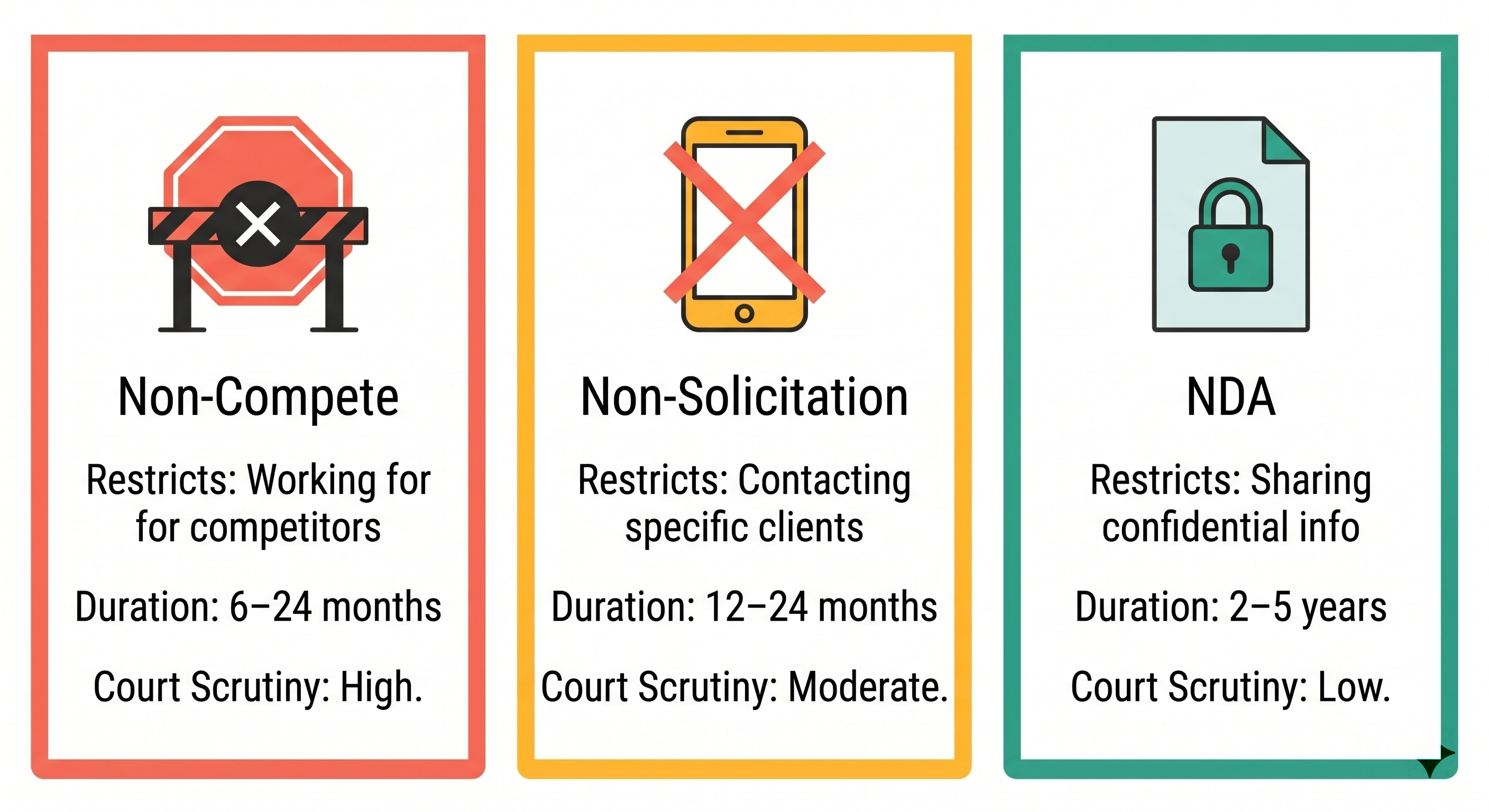
Non-competes are one of three common restrictive covenants in employment and business contracts. The others, non-solicitation agreements (which bar you from poaching specific clients or employees) and non-disclosure agreements (which bar sharing confidential information), restrict defined actions rather than your ability to earn a living. That distinction matters: courts apply far more aggressive scrutiny to non-competes because they directly limit a person's livelihood.
The Four Tests Courts Apply to Non-Competes
Whether a non-compete is enforceable depends entirely on your state and the clause's specific terms. A non-compete that blocks you from your entire industry for five years will almost certainly be struck down; one that restricts you from soliciting your former employer's top clients for 12 months is far more likely to hold. Courts in most U.S. jurisdictions evaluate enforceability through four tests. A clause that fails any single test is vulnerable.
Legitimate Business Interest
The employer must prove the non-compete protects something concrete: trade secrets, proprietary client relationships, specialized training the employer paid for, or confidential business strategy. A general desire to prevent competition is not a legitimate interest. Access to the company's pricing algorithms and its top-20 client list is.
This is the test most employers fail. If you're a warehouse worker or entry-level employee with no access to trade secrets or customer relationships, a non-compete claiming to protect "the company's competitive position" has weak legal footing.
Reasonable Duration
| Duration | Typical Court Treatment |
|---|---|
| 6 months or less | Generally enforceable across most states |
| 12 months | Standard; enforceable with a legitimate business interest |
| 24 months | Enforceable with strong justification; Florida presumes reasonable up to this threshold |
| 3+ years | Presumptively unreasonable; rarely enforced |
Florida's statute (§ 542.335) codifies these benchmarks explicitly: restrictions of six months or less carry a presumption of reasonableness, while those exceeding two years face a presumption of unreasonableness that the employer must overcome. Other states apply similar logic through case law rather than statute.
Reasonable Geographic Scope
The restriction must match where the employer actually competes. A pest control company operating in three counties can restrict you within a 25-mile radius of its service area. It cannot bar you from the entire state.
For remote workers, geographic scope is increasingly contested. A software engineer who worked remotely for a San Francisco company but lives in Atlanta faces an ambiguous restriction: does it apply to San Francisco, Atlanta, both, or nationwide? Courts are still developing consistent rules on remote work and non-compete geography.
Adequate Consideration
You must receive something of value in exchange for the restriction. For new hires, the job itself qualifies. For existing employees asked to sign a non-compete mid-employment, the calculus changes. Illinois, Oregon, Washington, and other states require additional consideration beyond continued employment: a raise, a bonus, stock options, or a defined severance package. If you are weighing a severance offer that includes a non-compete, our severance pay calculator estimates the package so you can judge whether the payment is fair for what you are giving up.
If your employer handed you a non-compete six months after you started and offered nothing new in return, the clause may be void for lack of consideration regardless of how reasonable its terms appear.
State-by-State Non-Compete Enforceability
Non-compete law is governed entirely at the state level. No federal statute or regulation prohibits them. The table below covers states with the most significant rules: outright bans, income-based restrictions, and notable enforcement patterns. For a complete 50-state reference, the Beck Reed Riden LLP noncompete chart is the most detailed free resource available, updated annually.
| State | Status | Key Rule | Citation |
|---|---|---|---|
| California | Banned | Void regardless of reasonableness; employers cannot require employees to sign one | Bus. & Prof. Code § 16600 |
| Minnesota | Banned | Prohibited as of July 1, 2023; applies to agreements signed after that date | Minn. Stat. § 181.988 |
| North Dakota | Banned | Near-total prohibition with narrow sale-of-business exception | N.D. Cent. Code § 9-08-06 |
| Oklahoma | Banned | Unenforceable; limited exception for sale-of-business agreements | Okla. Stat. tit. 15, § 219A |
| Colorado | Restricted | Prohibited for workers earning below $130,014/year (2026, adjusted annually) | C.R.S. § 8-2-113 |
| Illinois | Restricted | Void for employees earning $75,000/year or less (rises to $80,000 on January 1, 2027) | 820 ILCS 90/ |
| Massachusetts | Restricted | Maximum 12-month duration; requires garden leave pay or other mutually agreed consideration | Mass. Gen. Laws ch. 149, § 24L |
| Oregon | Restricted | Maximum 12-month duration; limited to employees earning above $116,427/year (2025, adjusted annually) | Or. Rev. Stat. § 653.295 |
| Washington | Restricted | Void for employees earning below $126,859/year (2026); state ban takes effect June 30, 2027 under ESHB 1155 | Wash. Rev. Code § 49.62 |
| Florida | Enforced | Statutory presumption of reasonableness for restrictions ≤ 6 months; unreasonableness for > 2 years | Fla. Stat. § 542.335 |
| Texas | Enforced | Enforceable if ancillary to an otherwise enforceable agreement and reasonable in scope | Tex. Bus. & Com. Code § 15.50 |
| Georgia | Enforced | 2011 constitutional amendment expanded enforcement; courts may modify overbroad clauses | Ga. Const. Art. III, § VI, ¶ V(c) |
States in the "restricted" column share a pattern: limiting non-competes to higher-earning employees who are more likely to possess trade secrets and client relationships that warrant the restriction. If you earn below your state's income threshold, the clause is void.
The FTC's Failed Ban and What It Means Now
In April 2024, the FTC voted 3-2 to ban non-compete agreements for most workers nationwide. The rule would have voided existing non-competes for all workers except senior executives and prohibited new ones entirely, with an effective date of September 4, 2024.
A federal court blocked it. In Ryan LLC v. FTC, Judge Ada Brown of the U.S. District Court for the Northern District of Texas vacated the rule on August 20, 2024, holding that the FTC exceeded its statutory authority under Section 6(g) of the FTC Act and that the rule was arbitrary and capricious under the APA. The decision applied nationwide, not just to the plaintiffs. The FTC dropped its appeal in September 2025, and the rule was removed from the Federal Register in February 2026.
No federal non-compete ban exists, and none appears likely given the current judicial and political situation. Non-competes remain a state-law question. The state-level trend, however, is clearly toward restriction: Colorado, Illinois, Minnesota, Oregon, and Washington all tightened their non-compete rules between 2020 and 2023.
Non-Compete vs. Non-Solicitation vs. NDA
These three restrictive covenants frequently appear in the same contract. They restrict different things, and courts treat them differently.
| Non-Compete | Non-Solicitation | NDA | |
|---|---|---|---|
| What it restricts | Working for competitors or starting a competing business | Contacting or recruiting specific clients, customers, or employees | Disclosing confidential information |
| What it allows | Nothing in the restricted field | Working for competitors, but not soliciting protected contacts | Working for competitors, but not sharing protected information |
| Typical duration | 6–24 months | 12–24 months | 2–5 years; indefinite for trade secrets |
| Court scrutiny level | High (limits livelihood directly) | Moderate (narrower restriction) | Lower (protects well-established legal interests) |
| General enforceability | Varies dramatically by state | Enforceable in most states if reasonable | Enforceable in nearly all states |
When negotiating, focus your effort on the non-compete. It carries the broadest career impact and the weakest legal footing. If the employer insists on restricting your post-employment activity, a non-solicitation clause protecting their specific clients is a narrower alternative that courts will actually enforce.
For founders and business partners, non-competes are commonly bundled into operating agreements alongside NDAs and IP assignments. The dynamics shift when co-founders part ways. Our guide to founder partnership agreements covers how these clauses interact during a business split.
How to Evaluate a Non-Compete Before You Sign
Work through these seven steps before signing any contract containing a non-compete.
1. Check your state's rules. Consult the table above or the Beck Reed Riden 50-State Noncompete Chart. If you're in California, Minnesota, North Dakota, or Oklahoma, the clause is almost certainly void, but confirm with local counsel because sale-of-business exceptions may apply.
2. Measure the duration. Twelve months or less falls within the standard enforceable range. Beyond 24 months, courts are far more likely to narrow it or void it outright.
3. Assess geographic scope. Does the restricted territory match where the employer actually operates? A nationwide restriction for a company that serves one metro area is a red flag for overbreadth.
4. Identify the stated business interest. The clause should name what it protects: trade secrets, client relationships, proprietary methods. If it says nothing more than "to protect the company's business interests," it's weaker.
5. Verify consideration. Did you receive the non-compete at hiring (where the job itself is the consideration) or mid-employment? If mid-employment, did you receive a raise, bonus, equity, or other tangible benefit? Without new consideration, the clause may be void in your state regardless of its terms.
6. Check for a severability clause. If the contract includes a severability provision, a court can narrow overbroad terms rather than voiding the non-compete entirely. This is standard in well-drafted contracts, and it works against you if you were hoping the court would throw out the whole clause.
7. Run it through a contract review tool. Pact's AI contract analyzer identifies non-compete sections and flags enforceability issues by state. It's iOS-only and will not replace an attorney for complex employment agreements, but it surfaces red flags in minutes, which makes your eventual attorney consultation faster and cheaper if you need one.
What Happens If You Violate a Non-Compete
Breaking an enforceable non-compete exposes you to two categories of legal action.
Injunctive relief is typically the employer's first move. They petition the court for a temporary restraining order or preliminary injunction forcing you to stop working for the competitor, sometimes within days of filing. Courts grant these injunctions when the non-compete appears facially valid and the employer demonstrates a risk of irreparable harm from lost trade secrets or client relationships.
Monetary damages follow if the case proceeds to trial. The employer can claim lost profits tied to your competitive activity, the cost of replacing you, and in states that allow it, attorney's fees. If you brought clients or proprietary knowledge to a competitor, damages escalate quickly. Your contract's limitation of liability clause may cap the employer's maximum recovery, but non-compete violations are frequently carved out from liability caps as intentional misconduct.
Most employers never file suit. Non-compete litigation costs the employer $20,000 to $100,000 or more in legal fees for contested enforcement actions. Employers frequently use non-competes as psychological deterrents, counting on the intimidation factor rather than actual litigation. Research by Evan Starr, J.J. Prescott, and Norman Bishara ("The Behavioral Effects of (Unenforceable) Contracts," Journal of Law, Economics, and Organization, 2020) found that workers routinely comply with non-competes even in states where they are unenforceable. Firms in those states are twice as likely to remind departing employees about their restrictions. The deterrent works even when the legal merits are thin.
Before violating a non-compete, get a legal opinion on whether the clause would hold up in your jurisdiction. The cost of a one-hour consultation (typically $200 to $500) is small relative to the cost of defending a lawsuit.
Frequently Asked Questions
Can my employer force me to sign a non-compete after I've already started working?
They can present one, but a mid-employment non-compete without new consideration is void in a growing number of states. See the adequate consideration test above. The bargaining angle most employees miss: your employer already invested in recruiting and training you. Pushing back with a shorter duration, narrower scope, or a garden leave provision is more likely to succeed than refusing outright.
Are non-competes enforceable against independent contractors?
Rarely. Most statutes target W-2 employees, and courts apply extra skepticism when the contractor had no access to trade secrets. If a client insists, propose a non-solicitation clause limited to their specific accounts. Courts enforce those readily, and the client gets the protection they actually need.
What is the blue-pencil doctrine?
Most U.S. states (roughly 40) allow courts to rewrite an overbroad non-compete rather than voiding it, narrowing duration, geography, or activity scope to an enforceable range. This works against employees: even a poorly drafted clause can bind you because the court fixes it instead of throwing it out. In states that reject blue-penciling, overbreadth kills the entire clause. Your contract's severability language influences which outcome applies.
Did the FTC ban non-compete agreements?
No. The April 2024 rule was vacated by a federal court in August 2024, the FTC dropped its appeal in September 2025, and the rule was removed from the Federal Register in February 2026. Non-competes remain a state-law question.
How long does a typical enforceable non-compete last?
Six to 24 months — the duration table above covers how courts treat each range. One factor the table does not capture: courts weigh duration against seniority and access. A two-year restriction on a C-suite executive with trade-secret exposure survives challenges that the same duration imposed on a mid-level employee would not.
Can I negotiate a non-compete clause?
Yes. Target four terms: duration (12 months instead of 24), geography (metro area instead of the entire state), competitor definition (named companies instead of broad industry categories), and a role carve-out (allowing unrelated positions at competing firms). If the employer will not narrow scope, request a garden leave clause with guaranteed salary during the restricted period. Garden leave is already required by law in Massachusetts and is gaining traction in other states.

About Vlad Kuzin
Founder & CEO, Shepherdstack LLC
Vlad Kuzin is the founder of Shepherdstack LLC and creator of Pact, an AI-powered contract review tool. He builds software that helps individuals and small businesses understand the documents they sign.
Disclosure: Founder of Shepherdstack LLC, the company behind Pact. All comparison articles use a standardized evaluation methodology applied equally to all tools, including Pact.